I’m finding it difficult to juggle everything. My intention is to be present with whatever I find in front of me. Which, quite frankly, is easier said than done.
It’s hard to be everywhere when you’re just one body, but have a mind that unfurls like tentacles, or the branches of a tree, stretching out in different directions at once.
And yet, here I am. One body. Two hands. Ten fingers (well, considerably more now, actually).


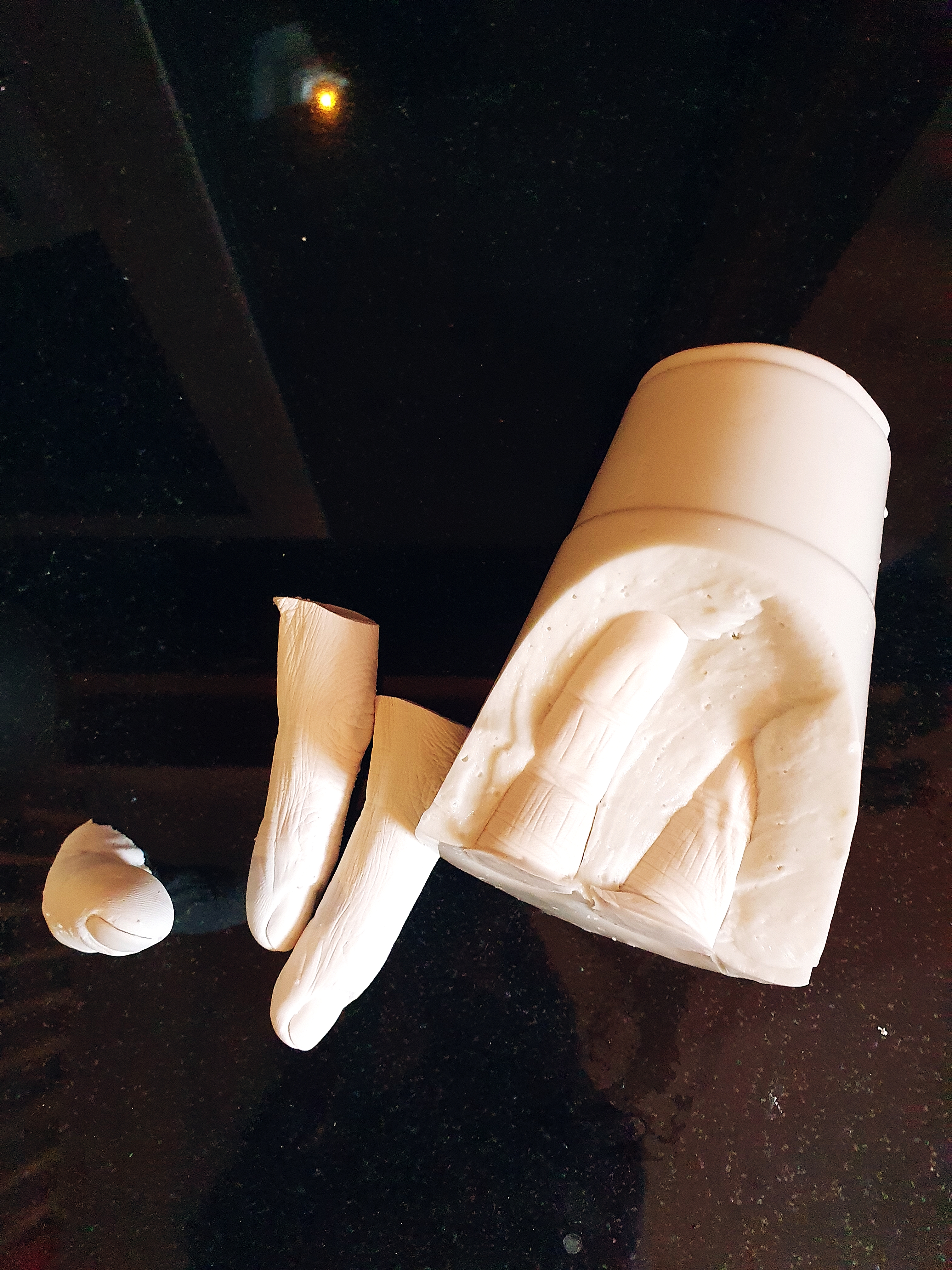
I’ve been making plaster casts of my fingers (don’t ask me why). Perhaps it has something to do with revisiting Merleau-Ponty’s The Visible and the Invisible (1968), particularly his chapter The Intertwining—The Chiasm. Or maybe it’s because hands symbolise, for me, a sort of threshold or bridge, on the one hand, and a way of communicating care, or in some cases harm, on the other. They have a language of their own. Anyway…
I’m not entirely sure where this is going, but I’ve been casting, handling, separating and rearranging these little fragments of myself. Each one carries the impression of something familiar: the creases of skin, the shape of a nail, the particular contours of a finger. And yet, once separated from the body, they become something rather strange.


In The Intertwining—The Chiasm, Merleau-Ponty explores the relationship between touching and being touched. He describes how one hand can touch the other, while the hand being touched can also touch in return. The body is not simply something that perceives the world; it is also something that can be perceived.
I’m particularly interested in his suggestion that there is a relationship between our movements, what we touch and what we come to know through that encounter.

— Merleau-Ponty, The Visible and the Invisible (1968), p. 133.
I’m wondering whether there’s a kind of reversal happening here. My fingers, ordinarily the means through which I touch and encounter the world, have become objects that I can touch and encounter in turn. The body that makes has, in some sense, become the thing made.
Of course, these plaster fingers cannot touch me back. But they carry something of the contact that brought them into being. An impression, a trace, a moment of encounter between my body and the material.
And then there’s the repetition. Making the same form again and again, each time producing something familiar, yet slightly different. Why does this aspect of making fascinate me so much?

Perhaps part of it is the way making draws me into the present moment. Something about the encounter with material, the repetition of a familiar technique, and the physical act of creating pulls me in (and why doesn’t time seem to exist in this space?). My attention might wander in a hundred different directions, but the process gives me something to return to. Something tangible, happening here and now.
And perhaps that’s another kind of return. Not necessarily to a memory, a material or an earlier piece of work, but to the present. To my body, to what I’m doing, to what’s immediately in front of me.
What does it mean to encounter a part of yourself as something separate from yourself? And what, if anything, remains of that original encounter?
And why, dammit, are there so many questions that I never feel any closer to answering?
Key points…
- Presence through the physical act of making.
- Making as a form of encounter and discovery.
- The relationship between touch, perception and knowledge.
- The body as both subject and object of exploration.
- Material as a carrier of traces and impressions.
- The relationship between presence and absence.
- Repetition as a method of exploration and return.
- The relationship between repetition, attention and presence.
- The experience of losing track of time through creative absorption.
- Making as a process of questioning rather than finding definitive answers.