Tag: Reflection

  • Post 14 (Wk. 4) – The Audience in my head…

    Post 14 (Wk. 4) – The Audience in my head…

    I missed last week’s lecture because I had my daughter with me for the first half of her half-term holiday, so I’ve been catching up with the recording.

    Something Mido said has stayed with me. She was talking about how difficult, perhaps even impossible, it feels to make work without considering an audience. Even when she’s creating something for herself, there’s always the possibility of someone else seeing it somewhere in the back of her mind.

    And I thought, yes, I do that too.

    Not that everything I make ever gets seen. Far from it.

    A considerable amount of my work lives in the attic, often in various stages of ‘dress’. Half-formed sculptures, unfinished experiments, abandoned ideas. A whole field of unfinished thoughts and lost dreams. Will they reawaken?

    But even when I’m making something that may never leave that space, I recognise that little awareness of someone else potentially encountering it.

    An imagined audience.

    And I wonder how much that awareness influences what I make, or how I make it.

    Later in the discussion, Illy spoke about wanting to create work that inspires a sense of awe in an audience. But what interested me was that he also wanted to experience that awe himself, as he already does, both through the process of making and through the outcome. (I can relate to this too).

    I found myself thinking about the difference between those experiences.

    There’s the experience of making something, with all its uncertainties, discoveries, frustrations and occasional moments of wonder. And then there’s the experience of encountering it, whether as the artist or as someone seeing it for the first time.

    They’re not necessarily the same thing.

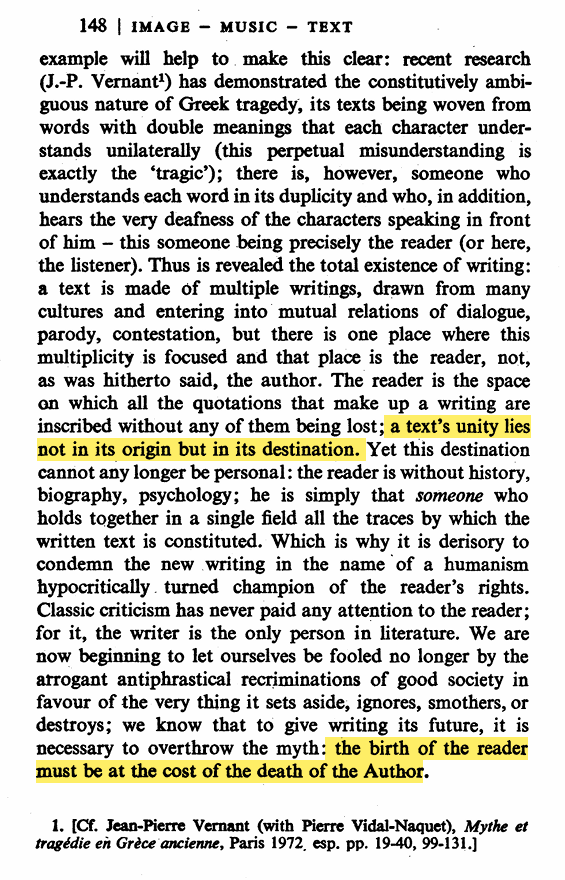
    Which reminded me of Roland Barthes and The Death of the Author.

    In his essay, Barthes writes:

    “A text’s unity lies not in its origin but in its destination.”

    — Roland Barthes, The Death of the Author, in Image–Music–Text (1977), p. 148.

    As I understand it, Barthes challenges the idea that the author’s intentions determine the meaning of a work. Once something exists beyond its creator, it becomes open to interpretation. The person encountering it brings their own experiences, beliefs, memories and associations.

    And whatever meaning they find might be quite different from what the artist intended.

    Not that the artist’s intention disappears, but it no longer has the final say.

    I’ve always found that rather interesting.

    We can spend so much time thinking about how something might be received, even though we have very little control over what someone else will actually take from it.

    We might hope to create awe, discomfort, recognition, connection or any number of other experiences. But we can’t guarantee any of them.

    And perhaps that’s part of what makes art interesting in the first place.

    It also makes me think about my own relationship with the objects I keep returning to.

    I’ve written about how, for me, certain objects become metaphorical anchors, helping me navigate things I can’t always articulate. But those meanings are mine, shaped by my experiences and the things I bring to the work.

    Someone else might encounter one of my chairs, for example, and see something entirely different.

    And actually, so might I.

    When I return to something I’ve made months or years later, I’m not necessarily the same person who made it. I bring new experiences, different questions, perhaps a little more understanding, or perhaps even less!

    So, in some strange way, I become an audience for my own work.

    And the meaning isn’t necessarily fixed for me either.

    Which brings me back to Mido’s observation.

    If we can’t entirely control how our work is received, why does the possibility of someone else seeing it occupy so much space in our minds while we’re making it?

    I find, more often than not, that imagined audience is a source of self-consciousness.

    It’s strange, really. I’m making something as a way of discovering what I don’t yet know, while simultaneously imagining how someone else might perceive it. Anticipating a response to something I haven’t even finished understanding myself!

    And I wonder what that does to the process.

    Does it make me more cautious? Less willing to experiment? More concerned with producing something that looks like art, rather than allowing myself to discover what the work might become?

    There’s a difference between wanting to share something and feeling as though I need to justify it.

    And perhaps that’s where I need to pay attention.

    Because I don’t think the audience itself is the problem. I love the possibility of connection, of something deeply personal resonating with someone whose experiences might be entirely different from mine.

    But I don’t want the anticipation of that encounter to determine what I’m willing to make.

    Especially when I have so little control over how it will be received anyway.

    And somewhere upstairs, my attic full of half-dressed sculptures and unfinished ideas continues to exist, largely untroubled by whether anyone ever sees them.

    And there’s something to learn from that.

    Key points…

    • An imagined audience can make me self-conscious and influence how I make.
    • Wanting to share my work is different from feeling I need to justify it.
    • I cannot control how others interpret my work.
    • Returning to my work can reveal new meanings.
    • Allow myself to discover through making, without worrying about how it will be received.
    • Unfinished doesn’t mean abandoned.
    • Some ideas may be waiting to reawaken.
  • Post 13: (Wk. 3) – A Body Made Using My Body…

    Post 13: (Wk. 3) – A Body Made Using My Body…

    Following our lecture the week before last, Jonathan gave us a task. Something along the lines of: Do something that might not work. Something that could fail.

    My mind, however, prefers to remember it as something closer to: Over yonder, a challenge awaits! Throw caution to the wind, venture into the unknown and proceed with boundless faith!

    So, naturally, I did.

    Well, nothing quite so heroic.

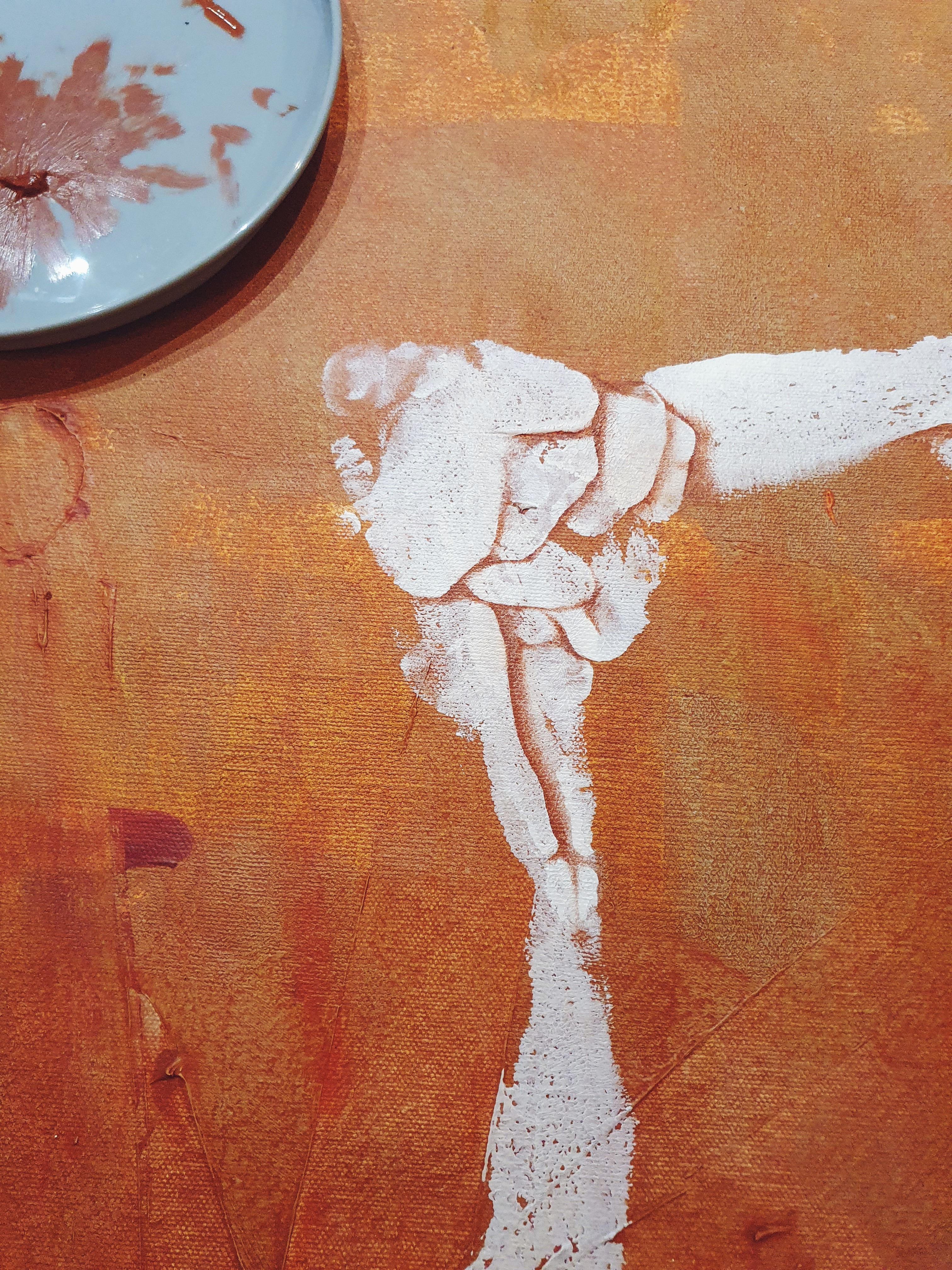
    Armed with a piece of canvas my daughter and I had filled with colour a couple of Saturdays earlier, I decided to paint a chair using my body.

    Then, at the beginning of this week’s session, Jonathan asked us what we’d done, if anything, and what we’d learned from the experience.

    I said I’d painted a chair using my body, and I had absolutely no idea what I’d learned!

    Which, having had a little more time to reflect, isn’t entirely true.

    I decided to make a chair (of course). This time, instead of building it with wire, clay, or any of the other materials I’ve been experimenting with, I painted it with my forearms and hands.

    And strangely, that felt like the most natural thing to do.

    I have this relationship with chairs.

    Yes, I know that sounds strange, but actually, this is what happens to me. I imbue things with meaning. Things others might find to be meaningless.

    But we all do that, don’t we?

    These objects become metaphorical anchors, or perhaps lighthouses. Physical things that occupy space and, in some strange way, help me understand something each time I return to them.

    For ages, I was obsessed with nipples.

    Well, not nipples exactly, but what they represented to me then. It was a form I kept returning to, an anchor through which I could explore my relationship with my mother and daughter (which, reading that back to myself, also sounds rather weird!), my maternal lineage, and all those things I feel about those relationships but can’t always articulate.

    And now, it seems, I have chairs.

    I don’t necessarily know what I’m looking for when I return to these objects. Nor do I think their meaning remains fixed. As I change, so do my encounters with these object.

    So, back to the painting.

    Using my forearms and different parts of my hands, I began building the chair’s skeletal structure directly onto the painted surface.

    The initial image reminded me of cave paintings. Something about the earthy colours, the marks and the direct relationship between my body and the surface.

    I then began working back into the painting with a brush, gradually building definition into the form, guided by the impressions left by the edges of my palms, forearms and fingertips.

    I’ve been thinking about Arthur Koestler’s idea of bisociation: bringing together two different frames of reference to create something new.

    And I wonder whether there’s something of that happening here.

    I began with a relatively uncontrolled way of making marks, using my body to establish the form, before introducing a more controlled tool to develop it further.

    What interests me is that one process informed the other. The brush didn’t erase or replace the bodily marks; it responded to them. I knew I wanted to make a chair, but I couldn’t entirely determine how those initial impressions would take shape.

    There’s something interesting in that space between intention and unpredictability. Between making a mark and responding to what it offers.

    And there it was. Another skeletal chair.

    A body made using my body.

    There’s something rather interesting about that. I’ve spent so much time thinking of the chair as something that holds or supports a body, yet here I was, using my own body to construct one.

    The marks themselves are records of contact. Impressions of skin, pressure and movement left behind on the surface.

    And I suppose that’s where the learning begins.

    When Jonathan asked what I’d learned, I couldn’t immediately articulate an answer. But that doesn’t necessarily mean I learned nothing.

    Maybe I simply hadn’t had enough time to recognise it.

    It brings me back to this recurring idea of the body as the first site of knowing. That there are different ways of knowing, some we might not immediately recognise or articulate.

    I’ve been thinking about Donald Schön’s ideas of knowing-in-action and reflection-in-action. I was drawing upon things I already knew through my body and previous experiences, responding to the marks as I made them, without necessarily being conscious of everything informing those decisions.

    Now, returning to the experience, I’m beginning to recognise what was happening.

    Understanding doesn’t always follow making. Some of it is already there, within the act itself, and reflection helps us bring it into view.

    Which brings me back to Jonathan’s question.

    What did I learn?

    I think I’ve been reminded that knowing and being able to articulate what we know aren’t necessarily the same. Making can be a form of knowing in itself, and sometimes it takes returning to the experience to recognise what was already happening.

    I’m repeating myself, and thats ok.

    After all, I keep returning to these things because there’s still something there for me to discover.

    I don’t know where this experiment will lead, or whether it will lead anywhere at all.

    For now, this chair is holding space for me while I find out.

    Key points…

    • Knowing and being able to articulate what I know aren’t necessarily the same.
    • Pay attention to the knowledge already present in my actions.
    • Allow less controlled processes to inform more deliberate decisions.
    • Different approaches to making can generate unexpected possibilities.
    • Reflection can reveal what I couldn’t recognise in the moment.
    • Familiar forms can become unfamiliar through different processes.
    • An experiment can remain unresolved and still offer something worth exploring.

  • Post 9: (Wk. 2) – We Are Researchers.

    Post 9: (Wk. 2) – We Are Researchers.

    I want to start with a quote from the philosopher Henri Bergson’s 1907 book Creative Evolution:

    “To exist is to change, to change is to mature, to mature is to go on creating oneself endlessly.”

    During our last lecture, Jonathan invited us to join an online lecture he was giving to students at Camberwell College of Arts. The topic was Practice-Based Research for Artists: A Messy Introduction.

    I’m so glad I attended!

    I’m reflecting a few days after the event, and life has wedged its way into all the pauses since then. So I’m going to do my best to think back to the 7th…

    (Note to self: your brain and you work better as a team when you reflect immediately after an event. Or perhaps this is another instance of being a slow processor. Maybe it’ll hit me after Christmas.)

    Practice-based research for (messy) artists.

    One of my main takeaways was the idea of an artist (me) being able to think on their (my) feet, or reflect-in-action.

    Jonathan introduced us to this concept through Donald A. Schön’s book The Reflective Practitioner: How Professionals Think in Action (1983).

    So, what does this actually mean?

    Well, here’s an excerpt from the book:

    “…both ordinary people and professional practitioners often think about what they are doing, sometimes even while doing it. Stimulated by surprise, they turn thought back on action and on knowing which is implicit in action […] As he tries to make sense of it, he also reflects on the understandings which he surfaces, criticizes, restructures, and embodies in further action […] It is this entire process of reflection-in-action which is central to the ‘art’ by which practitioners sometimes deal well with situations of uncertainty, instability, uniqueness, and value conflict.” (Schön, 1991, p. 50)

    It seems like a lot of what I do (consciously) is reflection-on-action (but even then I’m not particularly consistent, tut-tut). Because, as I’ve mentioned before, I make, leave, return, recognise differently, make again…

    Buuut I think I do a lot of reflection-in-action, too!

    It’s not something I’ve necessarily recognised myself doing. Or maybe I have, but life has clouded the pauses.

    Hang on. Am I reflecting-on-action about reflecting-in-action?

    Oh dear.

    I’ve described myself as a slow processor, but that doesn’t necessarily mean I’m slow to respond in the moment.

    When I’m making, I’m processing. Sometimes I’m working through experiences or feelings held in the body that I don’t necessarily have the language for. But through making, something happens. Connections emerge, things shift, and something becomes recognisable through the process itself.

    And repetition seems to play an important role in this. I can repeat a technique again and again, but each repetition reveals differences, both internally and externally. The action might be familiar, but something changes through the doing.

    So perhaps it’s not simply that I make first and understand later. Sometimes understanding is happening through the making itself, even if I can’t immediately articulate what I’m coming to understand.

    Which brings me back to something I wrote in my last post:

    “There is something here about learning to trust what I know without feeling the need to immediately explain how I know it.”

    And:

    “Perhaps I’m confusing the impossibility of saying everything with an inability to say anything.”

    (Yes, I’m quoting myself now. How cringe.)

    Which makes me wonder about the relationship between bodily knowing, repetition and reflection-in-action. Are these different processes? Do they overlap?

    I’m beginning to wonder what it is about repetition that lets something previously unrecognised, or hard to articulate, become perceptible. Not just in the finished work, but in me, in the material, and in the relationship between the two.

    Perhaps this is what I find so interesting about repetition. The action might be familiar, but something shifts through the doing. Almost like a zipper effect, where things begin to connect and fall into place. And not everything processed through making needs to become fully available to language to be meaningful.

    Something has happened. Something has changed. Even if I can’t quite explain what.

    And I suppose this is what excited me about Jonathan’s lecture. It has given me another way to think about what happens during the making itself, rather than only what I recognise when I return to the work afterwards.

    • Reflection doesn’t only happen after an experience. It can happen during the doing, through responding, questioning, adjusting and making decisions.
    • Being a slow processor doesn’t necessarily mean I’m slow to respond or think. Sometimes I’m processing through making long before I can articulate what is happening.
    • I’m beginning to recognise that both reflection-in-action and reflection-on-action are present in my practice, perhaps more than I’ve consciously acknowledged.
    • Repetition isn’t simply reproduction. Repeating an action or technique can reveal differences and bring about change, both internally and externally.
    • I’m interested in what repetition does: it allows (amongst many other things, I’m sure) something previously unrecognised, or difficult to articulate, to become perceptible—not just in the finished work, but in me, in the material, and in the relationship between us.
    • Bodily knowing, reflection, and repetition may overlap, but they aren’t necessarily the same. I’m curious how making might allow something be processed or understood without necessarily becoming fully available to language. Although how I might begin to investigate that is another question entirely…

    I think I need to leave it there for now. I might have confused myself.

    Why do I always end up with so many more questions than answers…?

  • Post 8: (Wk. 2) – Don’t Believe Everything You Think…

    Post 8: (Wk. 2) – Don’t Believe Everything You Think…

    We just finished today’s lecture. I was gearing up to say a little something about my practice, but there wasn’t enough time for everyone to share today. So next week it is. I had no idea what I would say anyway. I guess the anticipation is character-building.

    That said, I left feeling quite inadequate, and maybe a bit too intense. The session, the people, the art were lovely. I just get overly excited, and when I do, I become quite animated, and the fallout is overthinking.

    I have spent so long thinking (and feeling) how difficult it is to find the right words to express my experiences that I wonder whether I’ve created a bit of a self-fulfilling prophecy. I’ve almost convinced myself that I find it difficult to express anything through language.

    Well, that’s only half true.

    I can express myself. The problem is that I judge myself when I can’t do it perfectly—knowing full well there is no such thing.

    Perhaps I’m confusing the impossibility of saying everything with an inability to say anything.

    And I wonder whether this desire to explore, materially, the knowing held in the body is also some attempt to regain a sense of safety within my body. To trust it. To connect to something deeper, perhaps something ancestral.

    I’m not entirely sure what I mean by ancestral yet. Lineage? Inheritance? The ways of knowing carried through bodies, families, relationships, and generations? Maybe.

    There is something here about learning to trust what I know without feeling the need to immediately explain how I know it.

    Which is difficult for someone who apparently wants to explain everything perfectly.

    There she is again…

    Why can something feel okay in the moment and then, as soon as verbal/intellectual analysis enters the room, it wants to interrogate the experience?

    There is this strange tension between bodily participation and retrospective judgement. I experience something, then stand outside myself and examine it. Was I too loud? Too excited? Did I say too much? Did I say it properly?

    (Reminder: I haven’t even presented my work yet. Hilarious.)

    Perhaps the problem isn’t analysis itself. Reflection is, after all, partly what I’m here to do. Maybe it’s what happens when reflection becomes judgement. When what happened? quietly becomes what did I do wrong?

    I wonder whether making offers me a different kind of relationship with not knowing. I can manipulate something, respond to it, pull it apart, put it back together, leave it alone, come back to it. I don’t demand that the material explain itself to me immediately.

    I could extend the same courtesy to myself.

    The Accountability 3s was good. It was nice having some more quality time with members of the MA Fine Art: Digital cohort. And, ironically, it appears that I am not alone in not having everything figured out.

    I think the general consensus was that we’re all probably doing far better than we realise—not that anyone else expressed feeling particularly inadequate; that’s my own little contribution to proceedings. But we shared a sense that none of us needs to have everything figured out, and that the process is the exciting bit. It’s what we’re here for.

    So, I’m taking into this week the reminder that nothing needs to be resolved at this stage—or perhaps ever.

    Life is just one long trail of nows, after all.

    Maybe I can just be where I am while I’m there.

    Until I inevitably analyse it afterwards, obviously.

    Also, it was suggested that we look at the key points from our posts, which I think is great guidance. I often get lost in the narrative, the overthinking, or what-have-you. So, in the spirit of open-mindedness, the key points are:

    • I don’t need to express something perfectly for it to be worth expressing. Not being able to say everything isn’t the same as being unable to say anything.
    • I understand the body as the first site of knowing, with conscious understanding and language sometimes arriving later. I’m beginning to question whether I trust that knowing in myself, without feeling the need to immediately explain or justify it.
    • Bodily knowing doesn’t happen in isolation. Lived experience, relationships, family, lineage, culture, and what has come before shape it. These concerns have appeared in my work before, but I’m beginning to recognise their relationship to what I’m now calling bodily knowing.
    • There is a difference between reflection and judgement. What happened? can very quickly become What did I do wrong?
    • I’m noticing a recurring pattern of experience — interval — return — recognition in both my life and my making.
    • I allow materials to remain unresolved without demanding that they explain themselves immediately. Perhaps I can extend the same courtesy to myself.
    • Nothing needs to be resolved yet—or perhaps ever. The process is the point.

  • Post 4: (Wk. 1) – Kindness is like what…

    Post 4: (Wk. 1) – Kindness is like what…

    Reflection. Reflection. Reflection. Let’s see. How do I feel? Psychological safety. Yeah, that’s it. What a relief.

    Today’s lecture helped settle my nerves. It’s hard not to project expectations onto new experiences when I would much rather inhabit a beginner’s mindset, but I’m happy to say that many of the expectations I’d built up around returning to study — and the anxieties that came with them — were massively alleviated today.

    Everyone was lovely, encouraging, generous and engaged. I think we’re all eager to help nurture and contribute to this new creative community, and to expand as artists — as humans.

    We were placed into separate breakout rooms, which gave us the opportunity to have three-minute one-to-ones with one another. It was like speed dating, but strangely humanising and intimate in a rather hilarious way. But hey, humour is a great icebreaker.

    Once I’d got rid of the idea that perhaps we were part of some experiment where Zoom was the maze and we were rats in search of the big cheese, I felt myself starting to thaw out.

    The biggest relief came with the permission not to know. No one was actually telling me that I should know, of course, but perhaps that was just another one of those preconceived ideas I had brought with me. Logically, I know that I am here to learn, question and discover, but knowing something logically and actually believing it are sometimes two very different things.

    I wonder where my body picked up the belief that not knowing is somehow dangerous. Or at least, it seems to behave as though it is. There is an urge to know, to prepare, to anticipate, to get things right. Perhaps not knowing requires a certain amount of trust — trust that I can enter something without already knowing where it will lead.

    Which is strange, because this is precisely the kind of uncertainty I value in my practice. I don’t always want to know where making will lead. I want to be surprised by it. So perhaps one of my intentions will be to learn to extend that same generosity toward myself as a student, as well as toward my peers. It’s comforting to be reminded that we are all, on this course and beyond, just trying to figure it out.

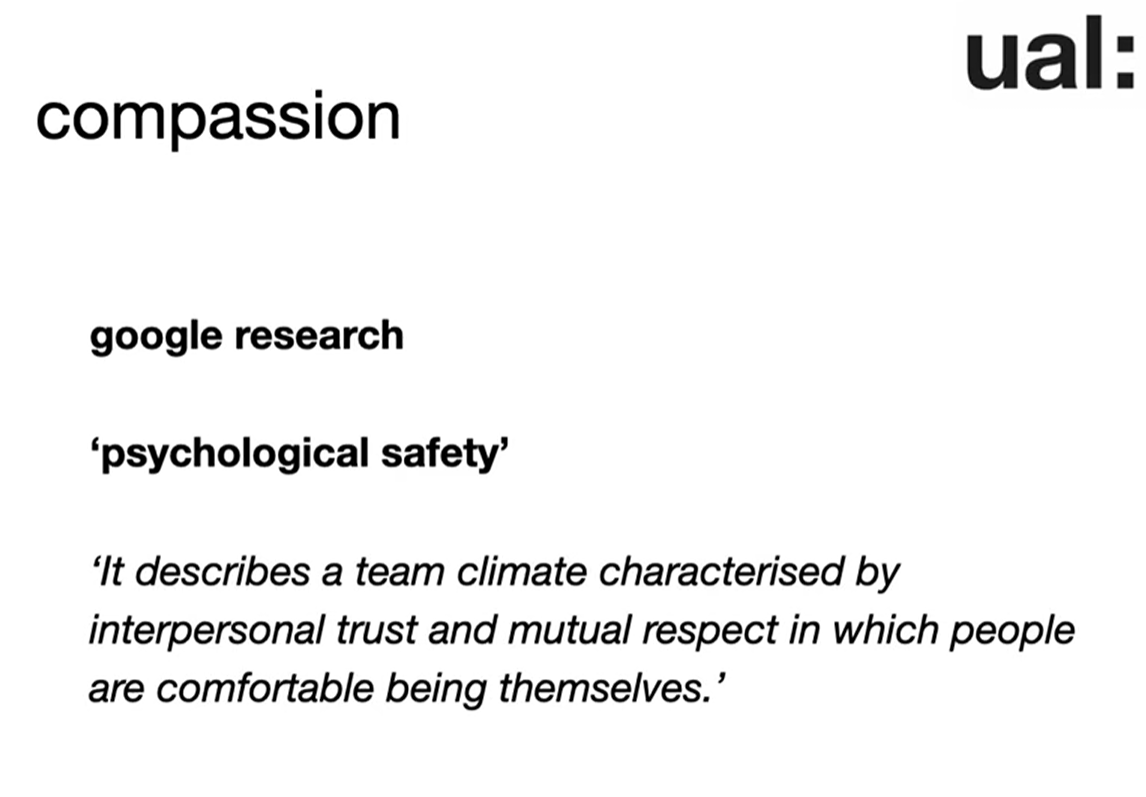
    Another takeaway from today was the importance of psychological safety: having the opportunity to speak, experiencing openness and being met with empathy. Perhaps these are some of the conditions that make not knowing feel a little less dangerous. We can’t necessarily create psychological safety for one another, but we can each play our part in creating the conditions that make it possible.

    And maybe that’s enough for day one. I don’t need to know yet. What a relief.

  • Post 3: Back to the Body…

    Post 3: Back to the Body…

    I’ve been trying to work out where to begin retracing this trajectory. The trouble is, the further back I look, the less convinced I am that there is a beginning.

    I carry with me a somewhat tumultuous history, and that followed me through the door when I walked back into art school after my daughter was born in 2021. What comes with this history are endless layers and blurred timelines that overlap and coil back on themselves.

    Just because the tapestry of my life creates an abstract image up close doesn’t mean that it has no meaning. There is. Lots. It’s just that most of that meaning seemed to have retreated into the sinews, nerves, muscle memory and fibres of my being.

    I didn’t have the words.

    That’s what they say about trauma. Sometimes an experience overwhelms our ability to process it as it happens. But just because something couldn’t be processed then doesn’t mean it wasn’t stored somewhere.

    The body…

    When I returned to art school, I quickly realised how difficult it was to remove context and self from the act of making. Whatever I made, there I was. My experiences, memories, the things I understood and those I didn’t yet have words for seemed to find their way into the work regardless.

    Perhaps what I didn’t understand then was that making was becoming a way of processing through the body what I couldn’t yet articulate in words. The actions, materials and repetitions weren’t simply illustrating an experience after it had happened; they were part of the process of trying to understand it.

    And what remained afterwards was, in some way, a record.

    Let Me Make Myself Pretty for You, 2022
    Single-channel video, 2 min 8 sec

    Let Me Make Myself Pretty for You… was a short film I made in response to a brief titled Extension to the Body. At the time, I approached the brief through the idea that the mind was an extension of the body. I was interested in the possibility that what we think and understand might not exist separately from bodily experience, but emerge through it.

    The title was deliberately ironic. In the film, I perform a ritual of making myself ‘pretty’, responding to internalised ideals of beauty and the anxiety of performing femininity — of being in a constant state of self-surveillance. As the ritual continues, however, I wrap Sellotape around my face. Rather than becoming increasingly ‘pretty’, the image becomes distorted, almost monstrous.

    Looking back, what interests me now is the gap between what I thought I was doing and what the work seems to reveal. I began with the idea of the mind as an extension of the body, but I don’t think I yet understood the implications of that. I made the work before I fully understood it. The action came first; some of the understanding followed afterwards.

    And perhaps this is one of the earliest places I can recognise something I am still trying to articulate: making as a form of embodied processing, with the work that remains carrying a trace of that process.

    Looking through the work that followed, this wasn’t an isolated occurrence. The body kept returning — sometimes deliberately, sometimes before I really understood why. Different works began to circle around similar questions: what the body knows, what it carries, and what might become visible through making that cannot so easily be articulated in words.

    Hold Space, 2024
    Multimedia installation, Bridewell Studios, Liverpool

    In 2024 I made Hold Space, a multimedia installation exploring the intermediate area of experience between mother and child. I was thinking about the relational space that exists between two people: where the boundaries of one body and another begin to blur, and where something might be held between them.

    Looking back now, I can also see Hold Space as a way of processing my own position between mother and child. I had become a mother myself, while still carrying the experience of being somebody’s daughter. The work was not explicitly autobiographical, but neither was I outside of it. My relationship with my own mother, my experience of becoming a mother, and the bodily knowledge of both seemed to find their way into the work.

    I think what I can recognise now is a shift taking place — from an interest in the body as a subject towards an understanding of the body as a site through which experience is known, carried and transformed.

    Un/body, 2025
    Multimedia installation, Liverpool Hope University, Liverpool

    This became more explicit in Un/body (2025), a multimedia installation in which I explored intergenerational transmission through my maternal genealogy. I wanted to uncover what I felt I might have inherited—experiences, patterns, and histories that seemed to exist within, or be carried by, the body.

    As part of the installation, I created moulds resembling nipples and used them repeatedly to produce latex forms. The repetition became important in itself. The act of making the same bodily form again and again became a space for processing something that was felt by the body but wasn’t necessarily available to me through language.

    The installation also included a soundscape made from recordings of women in my maternal family responding to a series of questions I had given them. Their voices brought other experiences and memories into the work, placing my own embodied experience within a wider maternal lineage.

    Looking back, I can see the body becoming more than something I was representing. It began to function as a kind of archive—somewhere experience could be carried, repeated, and transformed through making.

  • Post 2: Retracing…

    Post 2: Retracing…

    Hartenbos, South Africa, 2022. Photograph by the artist.

    Next week I start my MA Fine Art: Digital journey, so I thought it would be best to start retracing some of the paths that brought me here (well, there, nearly).

    I’ve had to take a short hiatus from making for the past few months while I learn to dance to a new rhythm in my life. Life is pesky like that sometimes; it shows up in all kinds of unexpected ways.

    Ways that, as usual, seem to resist easy articulation, but are nevertheless felt and known.

    I could give you a play-by-play of what has ensued, but it would just be a regurgitation of the facts as I see them, rather than the knowledge carried by the body through these experiences.

    Which is what interests me. Not only my body, but bodies — the body as the first site of knowledge. Before we can articulate, explain or make sense of an experience, the body has already lived it. Felt it. Known it.

    That’s where the good stuff lies — the real.

    So, naturally, perhaps retracing is a good place to begin.

    Not to construct a neat chronology of how I arrived here, because I’m not sure it ever happened that way. Looking back at my practice, the same questions seem to surface and resurface: the body, memory, repetition, maternal experience, rupture, what is carried, what is inherited, and what cannot quite be put into words.

    I don’t think I necessarily knew that these were the questions I was asking when I began. In many ways, the making came first and the understanding followed —along with yet more questions. It’s as if the more you know, the less you know. But there is such teachability in that.

    So, in retracing some of this trajectory, I’m interested not only in what I have researched and made, but in how one thing has led to another — how ideas have returned, shifted, accumulated and taken on different forms.

    Maybe the best place to start, then, is with the body.

    Throughout my practice so far, I have felt a deep desire to give physicality to feeling — to inner landscapes, to the bridges between inner and outer worlds. Perhaps this is because so many of those inner experiences have been felt in isolation.

    Why do I attach one meaning to an experience, while another person might attach something entirely different? Sometimes that meaning is known only by the body. Attempts to convey these experiences through words — and the meaning I attach to them — never seem able to fully encapsulate what has been felt.

    The materials, the processes, the making itself always seem to lead me back there. Back to the body. Back to this site, this beginning, where emotion precedes the word. Always.

    So, what happens when meaning is known only by the body? How can that knowledge be made visible? How can it be recorded?