Tag: Presence and Absence

  • Post 18: (Wk. 6) – Improvisation, Repetition and Other Things…

    Post 18: (Wk. 6) – Improvisation, Repetition and Other Things…

    I feel like I haven’t kept on top of things lately. I can’t even remember the last time I shaved my legs (for me, but still…).

    One of the many things I’m enjoying about the course so far is that it really is designed to match the rhythm of our individual lives. Except the rhythm of my life seems to be coming from a one-woman band, and she’s playing all the instruments strapped to her body with one arm. She has one leg, rides a skateboard and is dragging a grand piano for purely sentimental reasons, all while her five-year-old says ‘mum’ every two seconds.

    Nonetheless, things are wonderful, and I do love a bit of improv.

    Luckily, improvisation fits well with my practice. Earlier this week (or was it last week? Pfffphh… who needs to understand time?)I started making moulds of my fingers in alginate and pouring plaster into them to make a series of master moulds. At that point, I thought they were pretty groovy objects on their own.

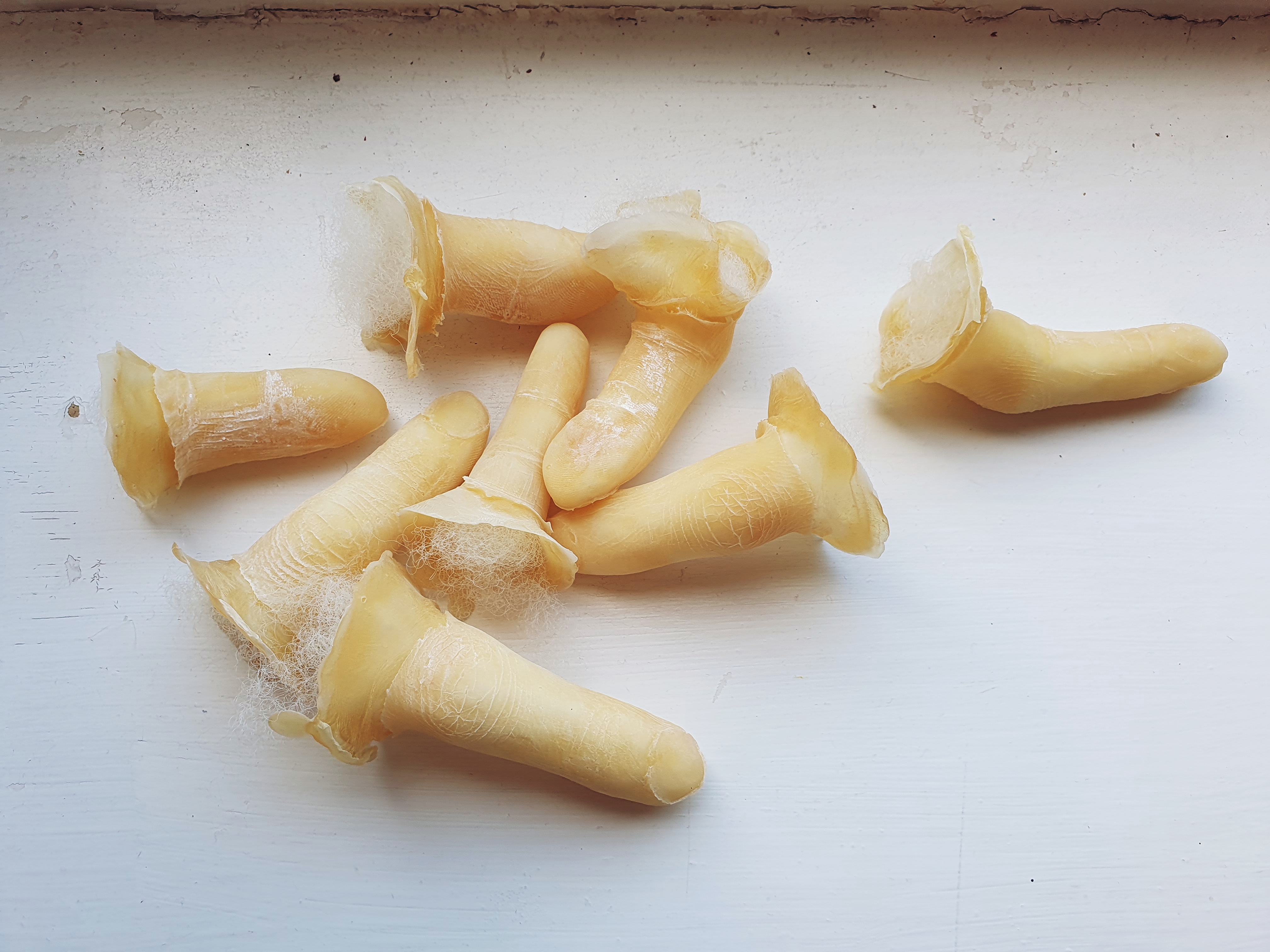
    But then I decided (oh surprise) to coat these plaster moulds in latex using a simple brush-on technique. I used some handy polymorph plastic I had lying around (great stuff!). I stuck them to a piece of wood and spent the day building up layers of latex-y goodness.

    I showed these images to a friend, who initially thought I was making something other than latex finger casts, but we won’t get into that.

    Anyway, from these phallic-y fingers—I mean fingers—I arrived at what I feel is a very satisfying outcome of the process so far. Another example of making that wasn’t predetermined, but developed through an encounter with something I’d already made. (IMPROV!)

    I love how latex has this incredible capacity to register even the finest details. Its surface becomes a record of contact, capturing, so intricately, the marks of something that was once present.

    It holds the memory of its encounters.

    Beyond material memory, there is also remembering through making. I’ve returned to an existing form: my fingers, which make so many things possible. Remade in plaster, they are translated once again into another material, with different physical properties and possibilities.

    During the pauses over the last couple of days, I’ve kept repeating this process, gradually building up these half-familiar, half-ambiguous forms made from my body.

    My body is both the origin of these forms and the agent of their transformation.

    Through casting, recasting and accumulating these forms, my fingers, which are so familiar to me that I barely even notice them, begin to become increasingly unfamiliar.

    An interesting relationship emerges between repetition, difference and estrangement.

    And then I came across this image from an old sketchbook. Apparently, I’ve been circling these ideas for quite some time!

    I’d previously encountered Deleuze’s ideas about repetition and difference through Bracha L. Ettinger’s writing, but also through my own making. And here I am, returning to them again, although not quite in the same way.

    What’s particularly interesting is that repetition doesn’t simply produce more of the same. It can change our relationship to the original. Something that was always present, but perhaps rarely consciously noticed, becomes visible in a different way.

    And perhaps that’s what’s happening with my research, too. I’m returning to something I’ve encountered before, but I’m encountering it differently because of everything I’ve made and experienced since.

    There’s something rather fitting about that. Even my research seems to be repeating itself!

    I wonder: am I repeating these forms to remember something, or is the repetition helping me discover something I didn’t know was there?

    Perhaps both.

    Key points…

    • Improvisation as a method of making and exploration.
    • Making as a process of encounter and discovery.
    • The relationship between material, touch and memory.
    • Material as a carrier of traces and impressions.
    • The relationship between presence and absence.
    • The body as both the origin of forms and the agent of their transformation.
    • Repetition as a method of exploration and return.
    • The relationship between repetition, difference and estrangement.
    • The familiar becoming unfamiliar through repeated encounters.
    • Returning to earlier ideas and encountering them differently.
    • Remembering as a process of discovery rather than simply recollection.
    • Making as a process of questioning rather than finding definitive answers.
  • Post 16: (Wk.5) – Presence…?

    Post 16: (Wk.5) – Presence…?

    I’m finding it difficult to juggle everything. My intention is to be present with whatever I find in front of me. Which, quite frankly, is easier said than done.

    It’s hard to be everywhere when you’re just one body, but have a mind that unfurls like tentacles, or the branches of a tree, stretching out in different directions at once.

    And yet, here I am. One body. Two hands. Ten fingers (well, considerably more now, actually).

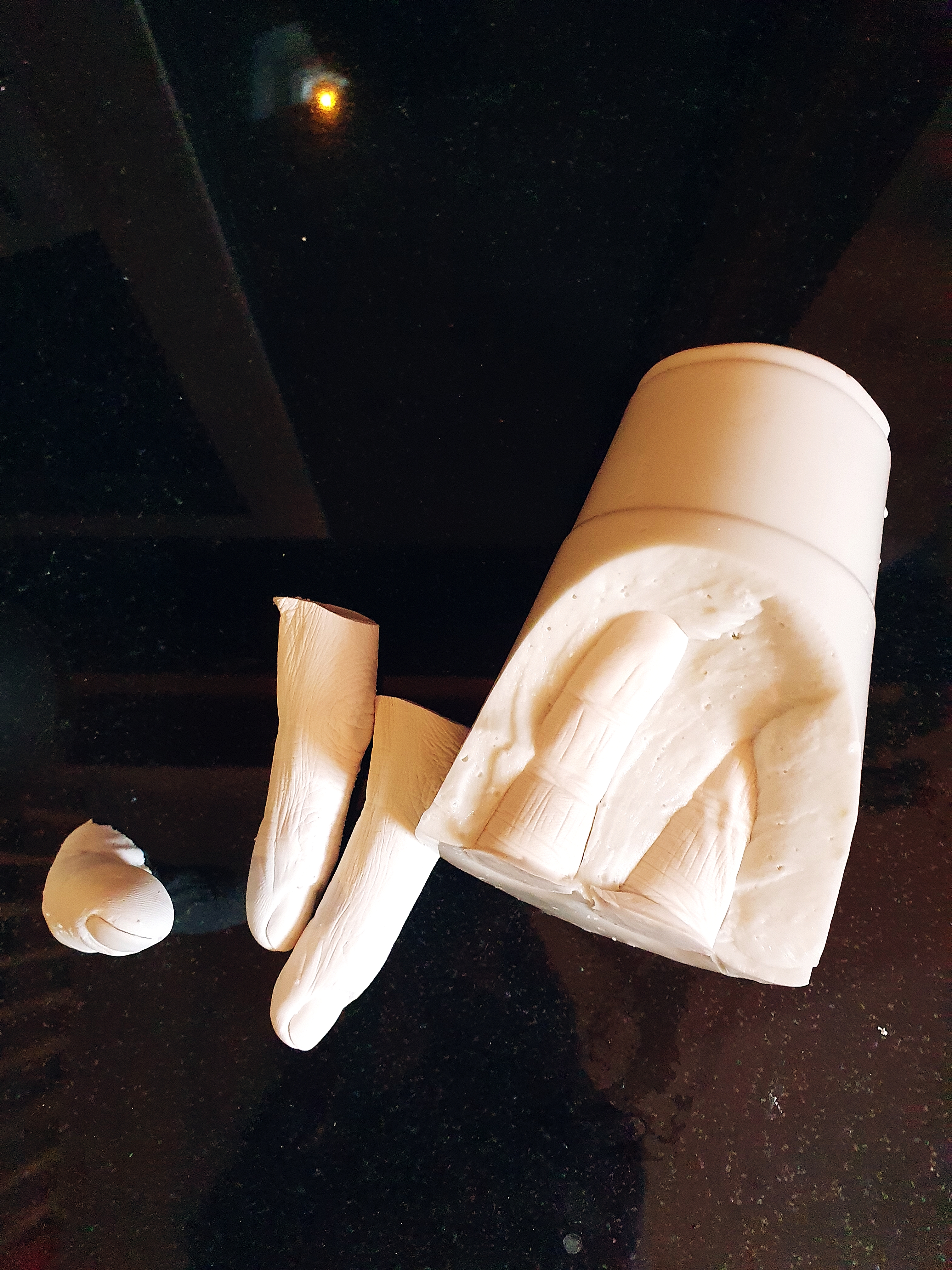
    I’ve been making plaster casts of my fingers (don’t ask me why). Perhaps it has something to do with revisiting Merleau-Ponty’s The Visible and the Invisible (1968), particularly his chapter The Intertwining—The Chiasm. Or maybe it’s because hands symbolise, for me, a sort of threshold or bridge, on the one hand, and a way of communicating care, or in some cases harm, on the other. They have a language of their own. Anyway…

    I’m not entirely sure where this is going, but I’ve been casting, handling, separating and rearranging these little fragments of myself. Each one carries the impression of something familiar: the creases of skin, the shape of a nail, the particular contours of a finger. And yet, once separated from the body, they become something rather strange.

    In The Intertwining—The Chiasm, Merleau-Ponty explores the relationship between touching and being touched. He describes how one hand can touch the other, while the hand being touched can also touch in return. The body is not simply something that perceives the world; it is also something that can be perceived.

    I’m particularly interested in his suggestion that there is a relationship between our movements, what we touch and what we come to know through that encounter.

    — Merleau-Ponty, The Visible and the Invisible (1968), p. 133.

    I’m wondering whether there’s a kind of reversal happening here. My fingers, ordinarily the means through which I touch and encounter the world, have become objects that I can touch and encounter in turn. The body that makes has, in some sense, become the thing made.

    Of course, these plaster fingers cannot touch me back. But they carry something of the contact that brought them into being. An impression, a trace, a moment of encounter between my body and the material.

    And then there’s the repetition. Making the same form again and again, each time producing something familiar, yet slightly different. Why does this aspect of making fascinate me so much?

    Perhaps part of it is the way making draws me into the present moment. Something about the encounter with material, the repetition of a familiar technique, and the physical act of creating pulls me in (and why doesn’t time seem to exist in this space?). My attention might wander in a hundred different directions, but the process gives me something to return to. Something tangible, happening here and now.

    And perhaps that’s another kind of return. Not necessarily to a memory, a material or an earlier piece of work, but to the present. To my body, to what I’m doing, to what’s immediately in front of me.

    What does it mean to encounter a part of yourself as something separate from yourself? And what, if anything, remains of that original encounter?

    And why, dammit, are there so many questions that I never feel any closer to answering?

    Key points…

    • Presence through the physical act of making.
    • Making as a form of encounter and discovery.
    • The relationship between touch, perception and knowledge.
    • The body as both subject and object of exploration.
    • Material as a carrier of traces and impressions.
    • The relationship between presence and absence.
    • Repetition as a method of exploration and return.
    • The relationship between repetition, attention and presence.
    • The experience of losing track of time through creative absorption.
    • Making as a process of questioning rather than finding definitive answers.

  • Post 10: (Wk. 3) – Noticed How Much I Love a Chair…

    Post 10: (Wk. 3) – Noticed How Much I Love a Chair…

    Other than needing to sit down a lot because, well, my body is knackered at the ripe old age of 36, I absolutely love a chair.

    I notice them everywhere.

    I can’t say for sure, but I imagine they’re among those objects that largely go unnoticed. They’re part of the quotidian, the everyday. So familiar, perhaps, that we barely give them a second thought.

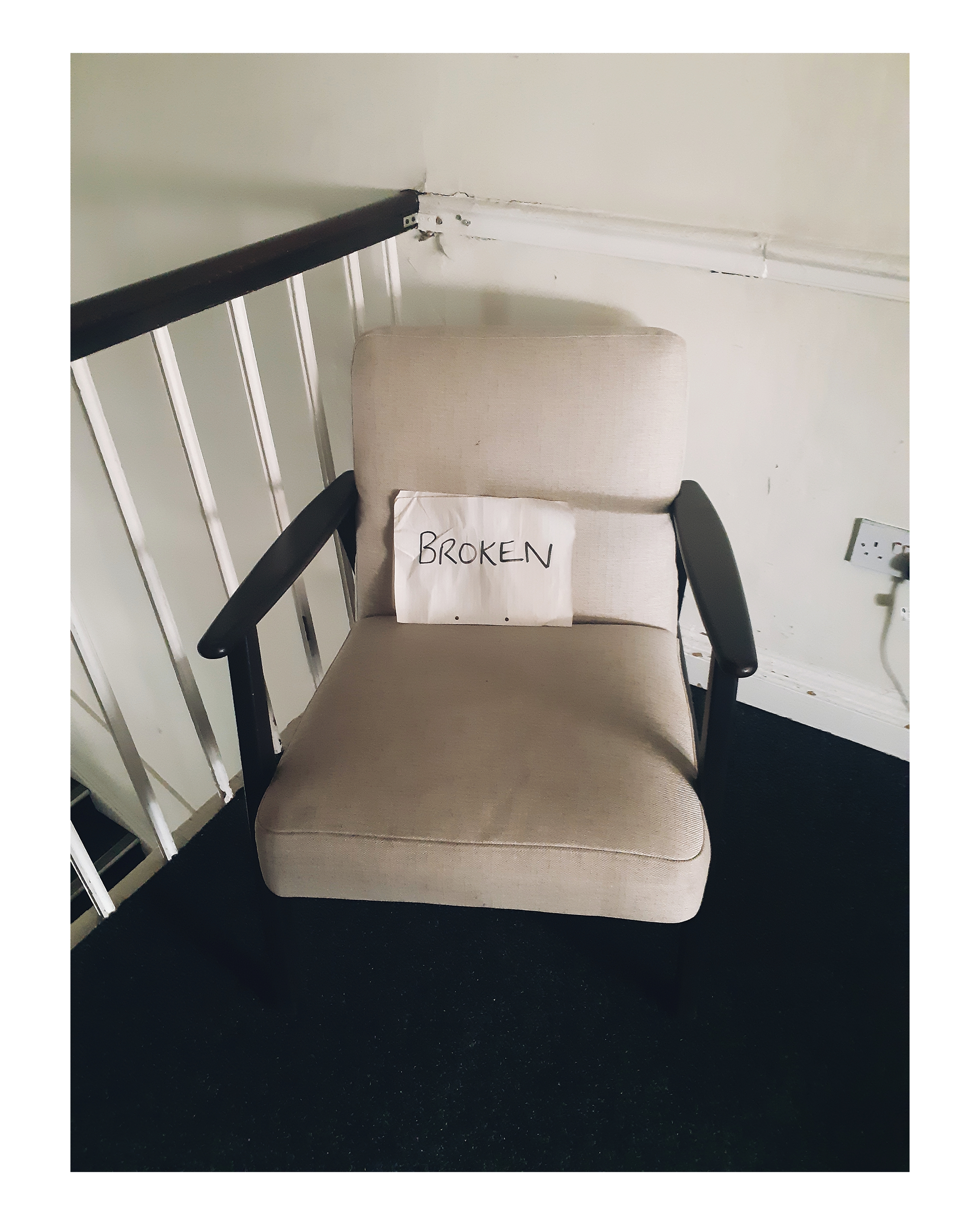
    And yet, I find myself increasingly drawn to them. Abandoned chairs, broken chairs, chairs that have been repaired, chairs that barely look like chairs at all. I’ve been photographing them, drawing them, gazing lovingly at them, making them, and generally finding myself rather preoccupied with them.

    This rather avid love affair, alongside my interest in the chair as a structure and its relationship to the body, has led me to include it in my research. Although I’ve always found chairs alluring, I didn’t begin exploring this fascination through my practice until I started Structures of Remembering in 2025.

    Although I suppose I’ve been exploring the ideas behind Structures of Remembering long before I had a name for what I was doing.

    The body, memory, lived experience, the ways in which we carry things with us, and how making might allow us to process what we don’t necessarily have the language for.

    I’ve spent much of my life living in my head, while my body has gone largely neglected. Which, come to think of it, might be another reason I’m so grateful for chairs.

    Before I go off on a tangent, which is so often the case, I think I should try to explain why I want to include chairs in my research.

    I wouldn’t say I’m close to nailing down my research question yet (not that I think there’s an expectation of that at this stage anyway), but I know it will build on concerns I’ve explored over the past four years of my practice, particularly repetition, embodied knowing, and how the process of making might allow something previously unrecognised to become perceptible.

    In my previous post, I began wondering what it is about repetition (another thing I’m obsessed with) that makes something previously unrecognised, or hard to articulate, perceptible. Not just in the finished work, but in me, in the material, and in the relationship between the two.

    And I suppose the chair offers me a familiar structure through which I might begin exploring some of these questions.

    It’s an object made in relation to the body. Something designed to support us, hold our weight, offer rest. But it can also suggest absence, vulnerability, or the failure of that support.

    And then there’s my own relationship with the chair, which I’ve begun to recognise differently through making and reflecting on the work.

    When I began Structures of Remembering in 2025, I wasn’t immediately conscious of all the associations I would come to make with it. Understanding slowly trickled in each time I returned to the work and reflected on my experiences; I began to recognise the chair as a structure that held particular meaning for me.

    A chair has been a place where I’ve felt held. Somewhere I’ve been anchored enough, surrounded by other chairs, to begin exploring experiences that had felt contained and suppressed within me for much of my life.

    Perhaps that’s why the chair keeps calling to me. Not simply as a symbol of support or absence, but as a familiar structure I can return to, repeat, alter, dismantle and remake.

    The key points are…

    • My interest in chairs predates Structures of Remembering, but I’ve been exploring them through my practice since 2025.
    • The chair offers a familiar structure for exploring relationships between the body, support, presence, and absence.
    • Repetition, embodied knowing, and the relationship between making and recognition have been recurring concerns throughout my practice.
    • Returning to my work and reflecting on my experiences has allowed me to recognise personal associations with the chair that weren’t necessarily apparent when I began.
    • I don’t need a definitive research question or a clear understanding of what the chair means just yet. Making, repeating, dismantling and remaking might offer ways of exploring these questions.

    So, more chairs it is, then.