Tag: Practice-Based Research

  • Post 15: (Wk. 5) – Tutorial – Yay! I’m Confused…

    Post 15: (Wk. 5) – Tutorial – Yay! I’m Confused…

    Look, I’m not going to pretend that I know what’s going on when I don’t. Well, at least I can’t yet see the whole picture and, let’s face it, I probably never will.

    Reassuringly, Jonathan said I’m exactly where I’m meant to be right now. Confused. That’s where I am, and I’m slowly coming to terms with being okay with that (no, it’s true).

    I was able to record our tutorial together, and while I still haven’t listened back to it, Jonathan encouraged me to write down some of the things that sprang to mind after our conversation.

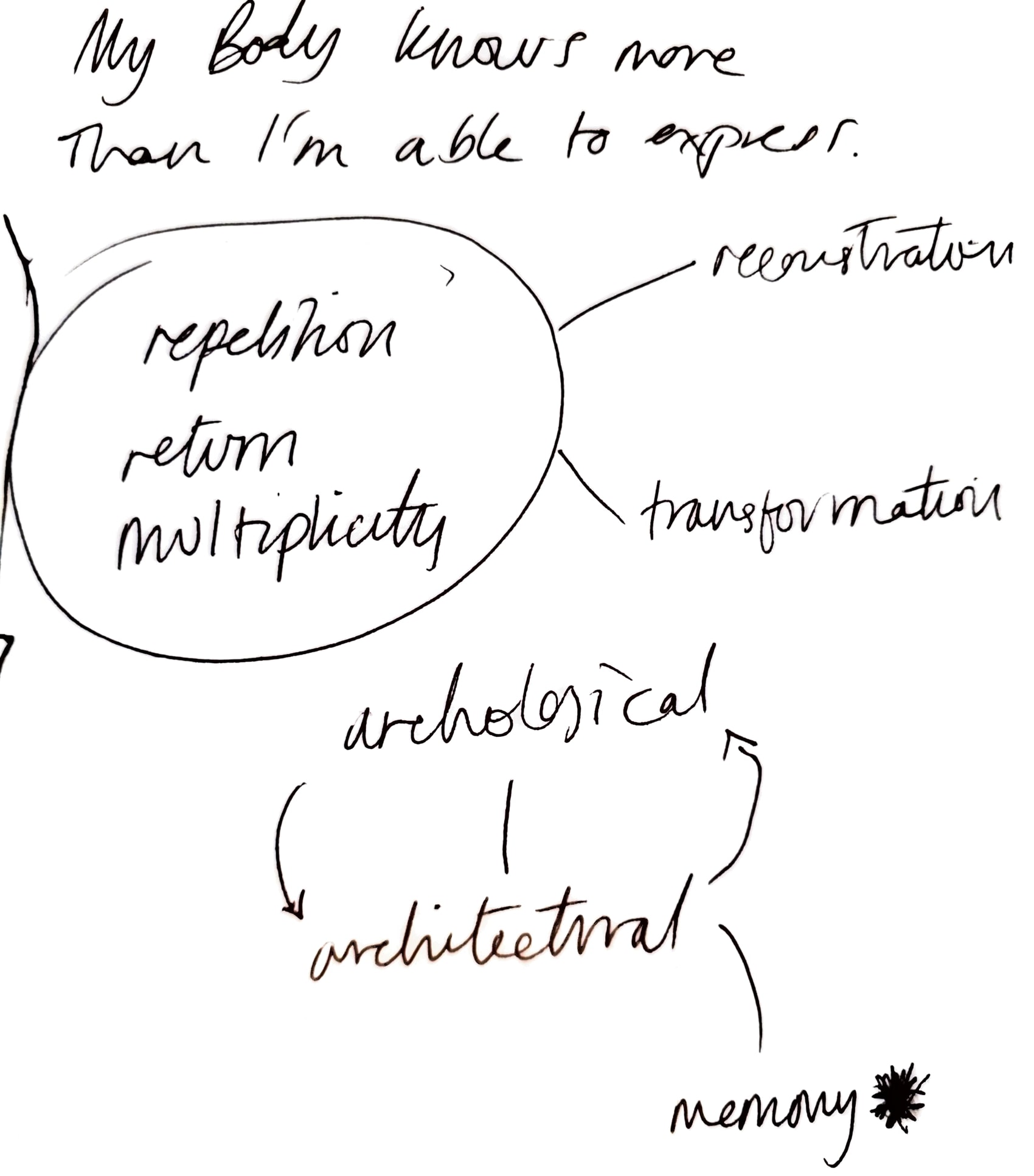
    At the risk of this making absolutely no sense, here are some things I scribbled down (believe in yourself!):

    Looking over my notes, what initially appears, at first glance, to be a collection of disparate ideas might actually be connected. Yeah, possibly.

    Repetition, return and multiplicity feel significant to my practice. Making over and over, repeating similar processes, producing iterations that are never quite the same. Returning to the work, encountering it again and again, each time perhaps seeing something I hadn’t noticed before.

    But when I return, what exactly am I returning to? The material? The process? A memory? An experience? And is it ever really the same thing I’m returning to? Things change.

    I’m beginning to think about the relationships that emerge through making. Between my body and the materials I work with, between bodies, and between bodies and the world. Between past and present, the visible and the invisible.

    And I keep coming back to this idea of the body as the first site of knowledge. What I’m starting to think, or at least what I now think I mean by this, is that it is through my body that I encounter and come to know the world. Through touching, seeing, moving, feeling and perceiving. But these encounters don’t happen in isolation, do they? I bring my history, my experiences, my memories (or sometimes the absence of them) into these encounters too.

    What happens when experiences cannot be consciously recalled or pieced together into a coherent narrative? Can something nevertheless feel familiar? Can we recognise something before we understand what it is we’re recognising? And might the process of making create opportunities for these encounters, for remembering, or even for forming new relationships with what has been experienced?

    Some of these connections probably already exist, waiting to be recognised. Perhaps others are formed through the process of making itself.

    I’m not entirely sure where all of this is leading, but I’m beginning to see connections where I hadn’t seen them before. And for now, that’s enough.

    So, I think I’m going to continue making through the methods that feel meaningful to me: repetition, return and multiplicity (thank you, Jonathan!). To keep exploring materials, repeating gestures, returning to familiar processes and seeing what emerges. Perhaps through making, I’ll begin to recognise connections I can’t yet articulate, as I have at times before, and discover relationships I hadn’t anticipated.

    I don’t need to understand it all just yet (thankfully). At the moment, it’s enough to keep making, returning, and seeing what happens.

    Key points…

    • Repetition and return can reveal new meanings and connections.
    • Each encounter with my work is different. Things change.
    • My body is how I encounter and come to know the world.
    • Bodies, materials, memories and experiences are intertwined.
    • Making may allow me to recognise what I cannot yet articulate.
    • Remembering may involve creating new relationships with past experiences.
    • Trust the process. Keep making, returning and seeing what emerges.
  • Post 9: (Wk. 2) – We Are Researchers.

    Post 9: (Wk. 2) – We Are Researchers.

    I want to start with a quote from the philosopher Henri Bergson’s 1907 book Creative Evolution:

    “To exist is to change, to change is to mature, to mature is to go on creating oneself endlessly.”

    During our last lecture, Jonathan invited us to join an online lecture he was giving to students at Camberwell College of Arts. The topic was Practice-Based Research for Artists: A Messy Introduction.

    I’m so glad I attended!

    I’m reflecting a few days after the event, and life has wedged its way into all the pauses since then. So I’m going to do my best to think back to the 7th…

    (Note to self: your brain and you work better as a team when you reflect immediately after an event. Or perhaps this is another instance of being a slow processor. Maybe it’ll hit me after Christmas.)

    Practice-based research for (messy) artists.

    One of my main takeaways was the idea of an artist (me) being able to think on their (my) feet, or reflect-in-action.

    Jonathan introduced us to this concept through Donald A. Schön’s book The Reflective Practitioner: How Professionals Think in Action (1983).

    So, what does this actually mean?

    Well, here’s an excerpt from the book:

    “…both ordinary people and professional practitioners often think about what they are doing, sometimes even while doing it. Stimulated by surprise, they turn thought back on action and on knowing which is implicit in action […] As he tries to make sense of it, he also reflects on the understandings which he surfaces, criticizes, restructures, and embodies in further action […] It is this entire process of reflection-in-action which is central to the ‘art’ by which practitioners sometimes deal well with situations of uncertainty, instability, uniqueness, and value conflict.” (Schön, 1991, p. 50)

    It seems like a lot of what I do (consciously) is reflection-on-action (but even then I’m not particularly consistent, tut-tut). Because, as I’ve mentioned before, I make, leave, return, recognise differently, make again…

    Buuut I think I do a lot of reflection-in-action, too!

    It’s not something I’ve necessarily recognised myself doing. Or maybe I have, but life has clouded the pauses.

    Hang on. Am I reflecting-on-action about reflecting-in-action?

    Oh dear.

    I’ve described myself as a slow processor, but that doesn’t necessarily mean I’m slow to respond in the moment.

    When I’m making, I’m processing. Sometimes I’m working through experiences or feelings held in the body that I don’t necessarily have the language for. But through making, something happens. Connections emerge, things shift, and something becomes recognisable through the process itself.

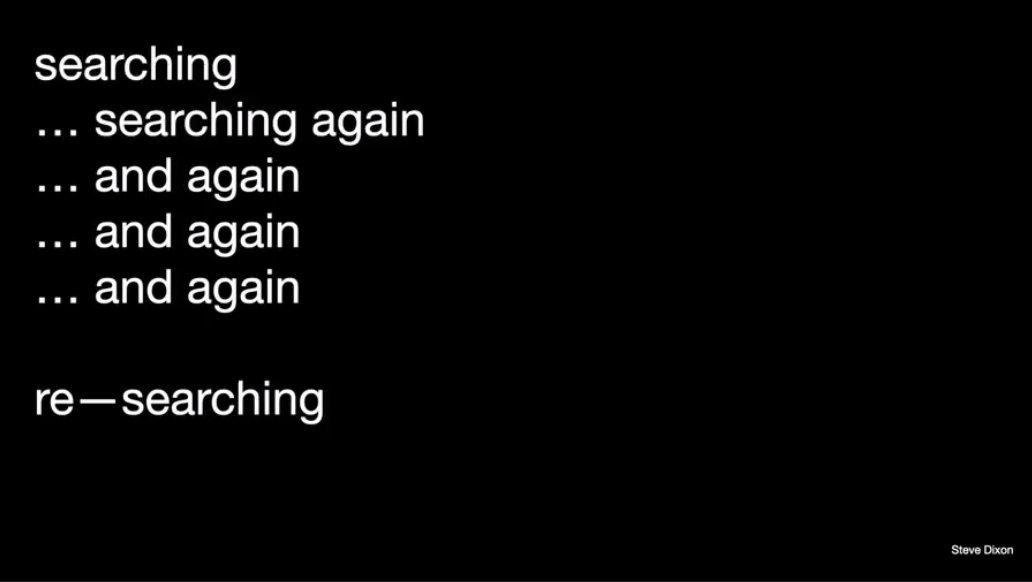
    And repetition seems to play an important role in this. I can repeat a technique again and again, but each repetition reveals differences, both internally and externally. The action might be familiar, but something changes through the doing.

    So perhaps it’s not simply that I make first and understand later. Sometimes understanding is happening through the making itself, even if I can’t immediately articulate what I’m coming to understand.

    Which brings me back to something I wrote in my last post:

    “There is something here about learning to trust what I know without feeling the need to immediately explain how I know it.”

    And:

    “Perhaps I’m confusing the impossibility of saying everything with an inability to say anything.”

    (Yes, I’m quoting myself now. How cringe.)

    Which makes me wonder about the relationship between bodily knowing, repetition and reflection-in-action. Are these different processes? Do they overlap?

    I’m beginning to wonder what it is about repetition that lets something previously unrecognised, or hard to articulate, become perceptible. Not just in the finished work, but in me, in the material, and in the relationship between the two.

    Perhaps this is what I find so interesting about repetition. The action might be familiar, but something shifts through the doing. Almost like a zipper effect, where things begin to connect and fall into place. And not everything processed through making needs to become fully available to language to be meaningful.

    Something has happened. Something has changed. Even if I can’t quite explain what.

    And I suppose this is what excited me about Jonathan’s lecture. It has given me another way to think about what happens during the making itself, rather than only what I recognise when I return to the work afterwards.

    • Reflection doesn’t only happen after an experience. It can happen during the doing, through responding, questioning, adjusting and making decisions.
    • Being a slow processor doesn’t necessarily mean I’m slow to respond or think. Sometimes I’m processing through making long before I can articulate what is happening.
    • I’m beginning to recognise that both reflection-in-action and reflection-on-action are present in my practice, perhaps more than I’ve consciously acknowledged.
    • Repetition isn’t simply reproduction. Repeating an action or technique can reveal differences and bring about change, both internally and externally.
    • I’m interested in what repetition does: it allows (amongst many other things, I’m sure) something previously unrecognised, or difficult to articulate, to become perceptible—not just in the finished work, but in me, in the material, and in the relationship between us.
    • Bodily knowing, reflection, and repetition may overlap, but they aren’t necessarily the same. I’m curious how making might allow something be processed or understood without necessarily becoming fully available to language. Although how I might begin to investigate that is another question entirely…

    I think I need to leave it there for now. I might have confused myself.

    Why do I always end up with so many more questions than answers…?