Tag: Material Language

  • Post 6: (Wk. 1) – I Forgot What I Was Remembering…

    Post 6: (Wk. 1) – I Forgot What I Was Remembering…

    I’ve always been a slow processor. I tend to realise things way after the fact. A bit of a space cadet, perhaps. Something happens, I wander off, and then sometime later I find myself going, ohhh… so that’s what that was about.

    Maybe that’s why returning feels so familiar to me.

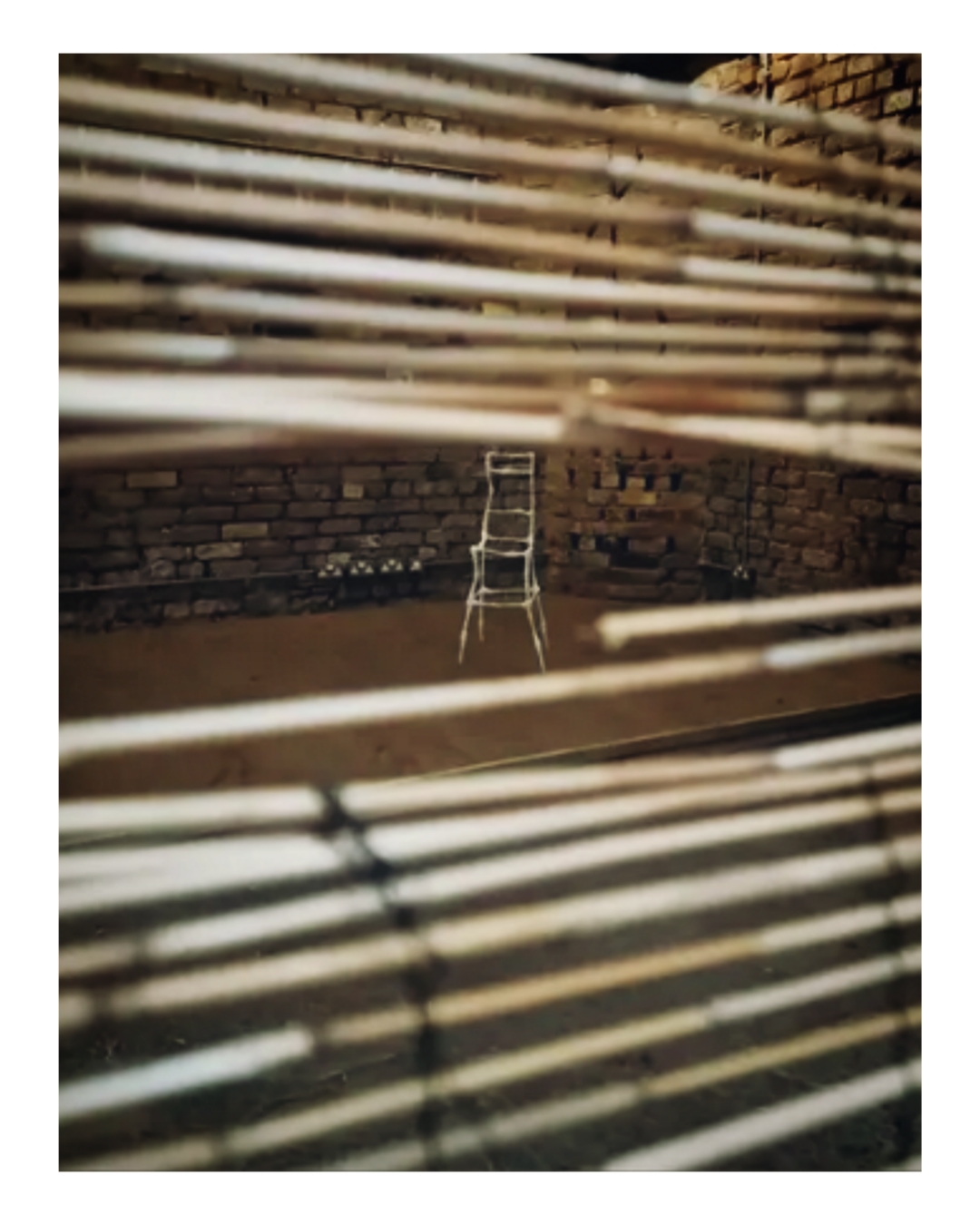
    Sometime in the middle to the end of last year, I began a body of work called Structures of Remembering. Some of the early work was shown as part of the group exhibition Traces: drawings, sketches and a fragile sculptural form, all circling around the image of a chair.

    At the time, I wrote:

    These works are traces of a process still unfolding—early thoughts, fragments, and impressions that hold the beginnings of a larger body of work.

    I wasn’t entirely sure what that larger body of work was yet.

    I knew there was something about the chair that I wanted to stay with. Its relationship to the body interested me. A chair is made in relation to a body. It holds its weight, offers support, invites presence, and when left empty can somehow make an absent body more visible. I was thinking about presence and absence, vulnerability, gathering, witnessing, healing and isolation. But mostly, I was circling. Making. Looking. Trying things out.

    And then life happened.

    I put Structures of Remembering on the back burner. Or perhaps I just forgot that there isn’t always such a clear distinction between art and life.

    I didn’t abandon it completely. I returned occasionally. Made something. Drew something. Picked at an idea. Left again. Some things were allowed to grow quietly in the background.

    Now, as I begin my MA, I’m digging some of those things up again.

    The idea that something can become known through making before I can articulate it through language isn’t entirely new to me. I’ve encountered it through other projects: making first, understanding later. What I hadn’t necessarily considered was whether the things I make might also be traces of that process—material remnants of trying to know, remember, or process something.

    Or perhaps I had considered it.

    I’m trying to remember.

    There is something quite fitting about not being sure.

    Looking back at what I wrote for Traces, I was already describing these works as “traces of a process still unfolding”. But I think, at the time, I understood that largely as the unfolding of a body of work: early thoughts, experiments and fragments that might eventually become something else.

    Now I’m wondering whether the process they trace is something less straightforward.

    Perhaps the making itself records a process of coming to know.

    I can see questions emerging that I couldn’t fully articulate at the time. The chair was there. The body was there, even in its absence. Ideas around support, vulnerability, presence, absence and what remains were there. I just didn’t know yet what they were becoming.

    Of course, I’m still not entirely sure.

    This isn’t to suggest that the work secretly contained an answer that I hadn’t figured out yet. That feels far too neat. Maybe making simply gave me somewhere to put things while I was still trying to understand them.

    I’m curious about what might happen if I approach the chair more deliberately from here. Not necessarily as a symbol with a fixed meaning, but as an object to think through—a structure I can return to, repeat, alter, dismantle and remake.

    If making can be a process of coming to know, what is left behind by that process? Could the things I make be understood as remnants of an encounter with something I couldn’t necessarily articulate beforehand? And if some of that knowing happens through the body, could what remains become a material record of what the body knows?

    I don’t know what that record would look like, or whether record is even the right word. Perhaps that’s something I want to test.

    Perhaps the chair gives me a structure through which to test this. It already carries a relationship to the body—holding it, supporting it, bearing its weight, registering its presence and making its absence visible. I want to see what happens when I keep returning to it through different materials, processes and repetitions.

    I don’t know what I’ll find yet. That’s the beauty of not knowing, I guess.

    Perhaps that’s why repetition and return keep finding their way into my work. I make something, leave it, encounter it again, and find that something has shifted. Sometimes the thing has changed. Sometimes I have. Usually, I suspect, it’s both.

    Something happened.
    Something remains.
    Something returns.
    But never quite the same.

    Perhaps putting Structures of Remembering aside wasn’t an interruption to the work at all. There was simply an interval.

    And life happened in it.

    Bodies continued. Relationships shifted. Things were lost, repeated, remembered and forgotten. Life kept accumulating. I just wasn’t calling it art.

    Maybe I’m not picking the project back up.

    Maybe I’m encountering it again.

    And this time, I’m looking at what remains.
  • Post 5: (Wk. 1) – An Aftertaste…

    Post 5: (Wk. 1) – An Aftertaste…

    You know when you chew on something, and it leaves an aftertaste that you only recognise afterwards…

    Anyway, as usual I’ve retraced, unpicked, put it back together, jiggled it a bit, and new or further meaning has revealed itself. So I have a little bit more to add. I guess the first post wasn’t enough for today.

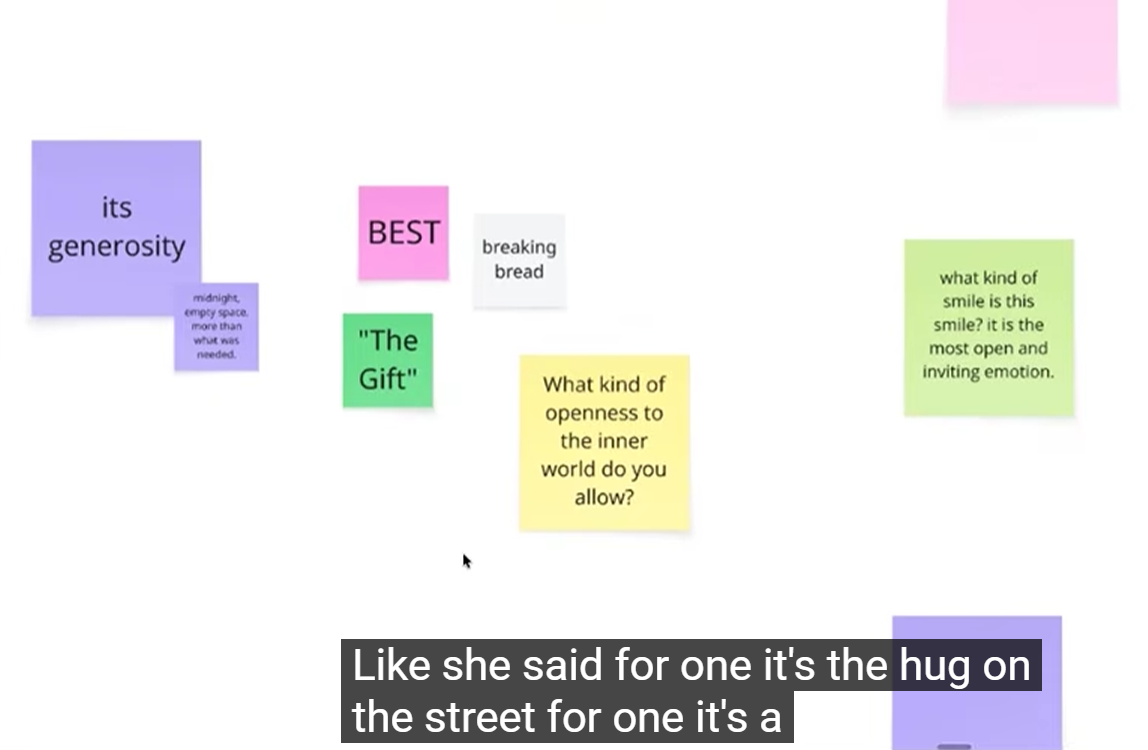
    I was thinking about how, when asked to reflect on what “kindness is like…”, so many of us took something which, in many respects, is quite abstract and described it through sensory or embodied experiences. There were existential and relational reflections too, but what interests me is how often we reach for something tangible, physical or experienced through the body to describe something felt in the body.

    A hug. A cup of tea. A warm blanket on a cold night. Breaking bread with a stranger. Listening. Smiling. Nourishment. A warm embrace.

    It’s like some things are easier to recognise through how they feel than through how we define them.

    Perhaps that is what I found so interesting about the exercise. None of this is necessarily new to me. The limitations of language, and the idea that the body might contain forms of knowledge that are difficult to articulate, are already central to my practice. But it brought me back to something I keep circling: how do we give the body a material language? Can making approach something that words can’t?

    I don’t mean simply using materials to represent an abstract idea, although that can be fun. I’m interested in whether something might actually become known through making. Perhaps bodily knowledge — the things we carry but cannot necessarily articulate — can be encountered through material, action and repetition. And perhaps what remains afterwards carries some trace of that encounter.

    A record of knowing? Not knowing? Remembering? Forgetting?

    I don’t know yet.

  • Post 2: Retracing…

    Post 2: Retracing…

    Hartenbos, South Africa, 2022. Photograph by the artist.

    Next week I start my MA Fine Art: Digital journey, so I thought it would be best to start retracing some of the paths that brought me here (well, there, nearly).

    I’ve had to take a short hiatus from making for the past few months while I learn to dance to a new rhythm in my life. Life is pesky like that sometimes; it shows up in all kinds of unexpected ways.

    Ways that, as usual, seem to resist easy articulation, but are nevertheless felt and known.

    I could give you a play-by-play of what has ensued, but it would just be a regurgitation of the facts as I see them, rather than the knowledge carried by the body through these experiences.

    Which is what interests me. Not only my body, but bodies — the body as the first site of knowledge. Before we can articulate, explain or make sense of an experience, the body has already lived it. Felt it. Known it.

    That’s where the good stuff lies — the real.

    So, naturally, perhaps retracing is a good place to begin.

    Not to construct a neat chronology of how I arrived here, because I’m not sure it ever happened that way. Looking back at my practice, the same questions seem to surface and resurface: the body, memory, repetition, maternal experience, rupture, what is carried, what is inherited, and what cannot quite be put into words.

    I don’t think I necessarily knew that these were the questions I was asking when I began. In many ways, the making came first and the understanding followed —along with yet more questions. It’s as if the more you know, the less you know. But there is such teachability in that.

    So, in retracing some of this trajectory, I’m interested not only in what I have researched and made, but in how one thing has led to another — how ideas have returned, shifted, accumulated and taken on different forms.

    Maybe the best place to start, then, is with the body.

    Throughout my practice so far, I have felt a deep desire to give physicality to feeling — to inner landscapes, to the bridges between inner and outer worlds. Perhaps this is because so many of those inner experiences have been felt in isolation.

    Why do I attach one meaning to an experience, while another person might attach something entirely different? Sometimes that meaning is known only by the body. Attempts to convey these experiences through words — and the meaning I attach to them — never seem able to fully encapsulate what has been felt.

    The materials, the processes, the making itself always seem to lead me back there. Back to the body. Back to this site, this beginning, where emotion precedes the word. Always.

    So, what happens when meaning is known only by the body? How can that knowledge be made visible? How can it be recorded?