Following our lecture the week before last, Jonathan gave us a task. Something along the lines of: Do something that might not work. Something that could fail.
My mind, however, prefers to remember it as something closer to: Over yonder, a challenge awaits! Throw caution to the wind, venture into the unknown and proceed with boundless faith!
So, naturally, I did.
Well, nothing quite so heroic.
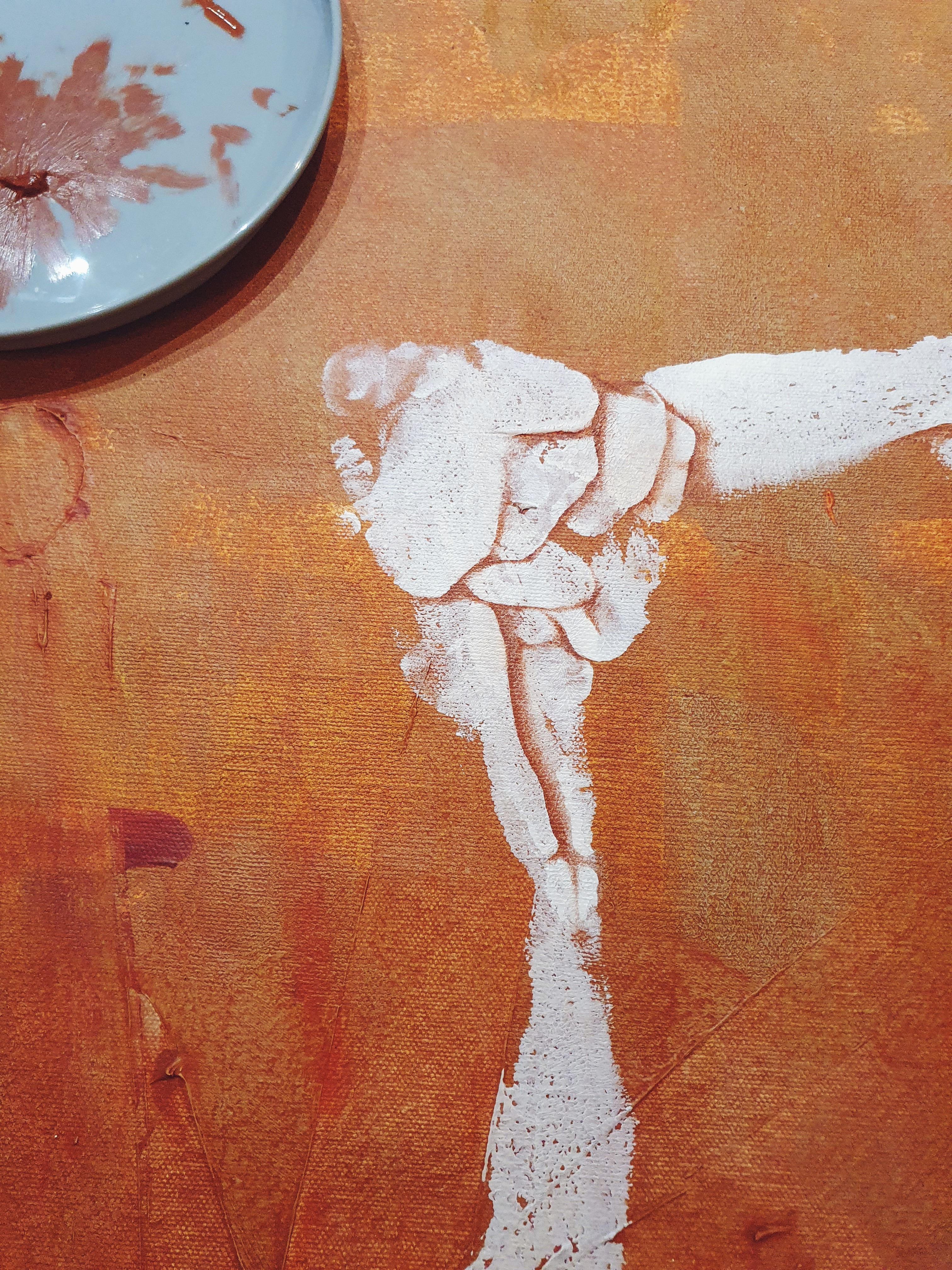
Armed with a piece of canvas my daughter and I had filled with colour a couple of Saturdays earlier, I decided to paint a chair using my body.
Then, at the beginning of this week’s session, Jonathan asked us what we’d done, if anything, and what we’d learned from the experience.
I said I’d painted a chair using my body, and I had absolutely no idea what I’d learned!
Which, having had a little more time to reflect, isn’t entirely true.
I decided to make a chair (of course). This time, instead of building it with wire, clay, or any of the other materials I’ve been experimenting with, I painted it with my forearms and hands.
And strangely, that felt like the most natural thing to do.

I have this relationship with chairs.
Yes, I know that sounds strange, but actually, this is what happens to me. I imbue things with meaning. Things others might find to be meaningless.
But we all do that, don’t we?
These objects become metaphorical anchors, or perhaps lighthouses. Physical things that occupy space and, in some strange way, help me understand something each time I return to them.
For ages, I was obsessed with nipples.
Well, not nipples exactly, but what they represented to me then. It was a form I kept returning to, an anchor through which I could explore my relationship with my mother and daughter (which, reading that back to myself, also sounds rather weird!), my maternal lineage, and all those things I feel about those relationships but can’t always articulate.
And now, it seems, I have chairs.
I don’t necessarily know what I’m looking for when I return to these objects. Nor do I think their meaning remains fixed. As I change, so do my encounters with these object.
So, back to the painting.
Using my forearms and different parts of my hands, I began building the chair’s skeletal structure directly onto the painted surface.

The initial image reminded me of cave paintings. Something about the earthy colours, the marks and the direct relationship between my body and the surface.
I then began working back into the painting with a brush, gradually building definition into the form, guided by the impressions left by the edges of my palms, forearms and fingertips.
I’ve been thinking about Arthur Koestler’s idea of bisociation: bringing together two different frames of reference to create something new.
And I wonder whether there’s something of that happening here.
I began with a relatively uncontrolled way of making marks, using my body to establish the form, before introducing a more controlled tool to develop it further.
What interests me is that one process informed the other. The brush didn’t erase or replace the bodily marks; it responded to them. I knew I wanted to make a chair, but I couldn’t entirely determine how those initial impressions would take shape.
There’s something interesting in that space between intention and unpredictability. Between making a mark and responding to what it offers.
And there it was. Another skeletal chair.
A body made using my body.
There’s something rather interesting about that. I’ve spent so much time thinking of the chair as something that holds or supports a body, yet here I was, using my own body to construct one.
The marks themselves are records of contact. Impressions of skin, pressure and movement left behind on the surface.


And I suppose that’s where the learning begins.
When Jonathan asked what I’d learned, I couldn’t immediately articulate an answer. But that doesn’t necessarily mean I learned nothing.
Maybe I simply hadn’t had enough time to recognise it.
It brings me back to this recurring idea of the body as the first site of knowing. That there are different ways of knowing, some we might not immediately recognise or articulate.
I’ve been thinking about Donald Schön’s ideas of knowing-in-action and reflection-in-action. I was drawing upon things I already knew through my body and previous experiences, responding to the marks as I made them, without necessarily being conscious of everything informing those decisions.
Now, returning to the experience, I’m beginning to recognise what was happening.
Understanding doesn’t always follow making. Some of it is already there, within the act itself, and reflection helps us bring it into view.
Which brings me back to Jonathan’s question.
What did I learn?
I think I’ve been reminded that knowing and being able to articulate what we know aren’t necessarily the same. Making can be a form of knowing in itself, and sometimes it takes returning to the experience to recognise what was already happening.
I’m repeating myself, and thats ok.
After all, I keep returning to these things because there’s still something there for me to discover.
I don’t know where this experiment will lead, or whether it will lead anywhere at all.
For now, this chair is holding space for me while I find out.
Key points…
- Knowing and being able to articulate what I know aren’t necessarily the same.
- Pay attention to the knowledge already present in my actions.
- Allow less controlled processes to inform more deliberate decisions.
- Different approaches to making can generate unexpected possibilities.
- Reflection can reveal what I couldn’t recognise in the moment.
- Familiar forms can become unfamiliar through different processes.
- An experiment can remain unresolved and still offer something worth exploring.