Tag: Chairs

  • Post 13: (Wk. 3) – A Body Made Using My Body…

    Post 13: (Wk. 3) – A Body Made Using My Body…

    Following our lecture the week before last, Jonathan gave us a task. Something along the lines of: Do something that might not work. Something that could fail.

    My mind, however, prefers to remember it as something closer to: Over yonder, a challenge awaits! Throw caution to the wind, venture into the unknown and proceed with boundless faith!

    So, naturally, I did.

    Well, nothing quite so heroic.

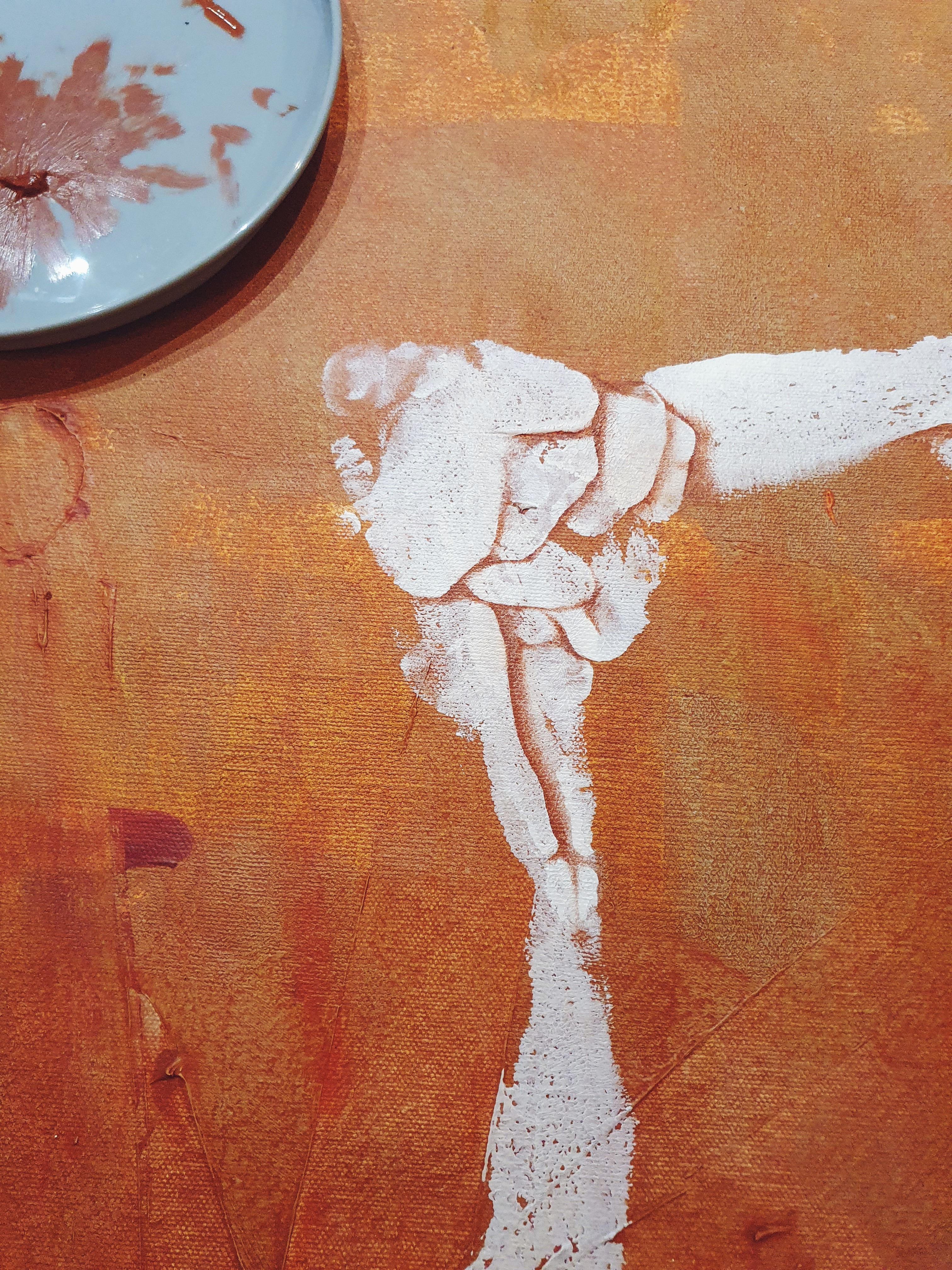
    Armed with a piece of canvas my daughter and I had filled with colour a couple of Saturdays earlier, I decided to paint a chair using my body.

    Then, at the beginning of this week’s session, Jonathan asked us what we’d done, if anything, and what we’d learned from the experience.

    I said I’d painted a chair using my body, and I had absolutely no idea what I’d learned!

    Which, having had a little more time to reflect, isn’t entirely true.

    I decided to make a chair (of course). This time, instead of building it with wire, clay, or any of the other materials I’ve been experimenting with, I painted it with my forearms and hands.

    And strangely, that felt like the most natural thing to do.

    I have this relationship with chairs.

    Yes, I know that sounds strange, but actually, this is what happens to me. I imbue things with meaning. Things others might find to be meaningless.

    But we all do that, don’t we?

    These objects become metaphorical anchors, or perhaps lighthouses. Physical things that occupy space and, in some strange way, help me understand something each time I return to them.

    For ages, I was obsessed with nipples.

    Well, not nipples exactly, but what they represented to me then. It was a form I kept returning to, an anchor through which I could explore my relationship with my mother and daughter (which, reading that back to myself, also sounds rather weird!), my maternal lineage, and all those things I feel about those relationships but can’t always articulate.

    And now, it seems, I have chairs.

    I don’t necessarily know what I’m looking for when I return to these objects. Nor do I think their meaning remains fixed. As I change, so do my encounters with these object.

    So, back to the painting.

    Using my forearms and different parts of my hands, I began building the chair’s skeletal structure directly onto the painted surface.

    The initial image reminded me of cave paintings. Something about the earthy colours, the marks and the direct relationship between my body and the surface.

    I then began working back into the painting with a brush, gradually building definition into the form, guided by the impressions left by the edges of my palms, forearms and fingertips.

    I’ve been thinking about Arthur Koestler’s idea of bisociation: bringing together two different frames of reference to create something new.

    And I wonder whether there’s something of that happening here.

    I began with a relatively uncontrolled way of making marks, using my body to establish the form, before introducing a more controlled tool to develop it further.

    What interests me is that one process informed the other. The brush didn’t erase or replace the bodily marks; it responded to them. I knew I wanted to make a chair, but I couldn’t entirely determine how those initial impressions would take shape.

    There’s something interesting in that space between intention and unpredictability. Between making a mark and responding to what it offers.

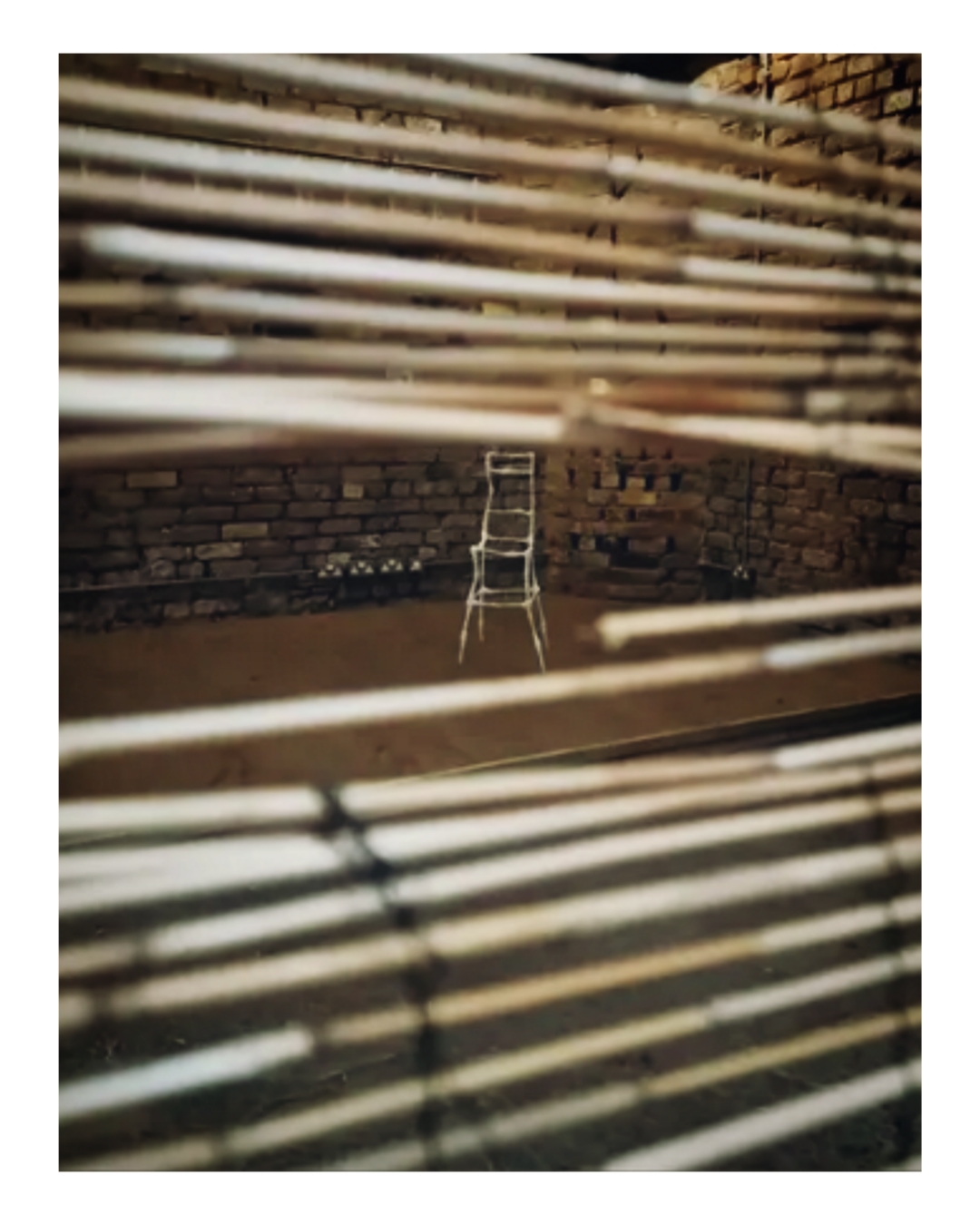
    And there it was. Another skeletal chair.

    A body made using my body.

    There’s something rather interesting about that. I’ve spent so much time thinking of the chair as something that holds or supports a body, yet here I was, using my own body to construct one.

    The marks themselves are records of contact. Impressions of skin, pressure and movement left behind on the surface.

    And I suppose that’s where the learning begins.

    When Jonathan asked what I’d learned, I couldn’t immediately articulate an answer. But that doesn’t necessarily mean I learned nothing.

    Maybe I simply hadn’t had enough time to recognise it.

    It brings me back to this recurring idea of the body as the first site of knowing. That there are different ways of knowing, some we might not immediately recognise or articulate.

    I’ve been thinking about Donald Schön’s ideas of knowing-in-action and reflection-in-action. I was drawing upon things I already knew through my body and previous experiences, responding to the marks as I made them, without necessarily being conscious of everything informing those decisions.

    Now, returning to the experience, I’m beginning to recognise what was happening.

    Understanding doesn’t always follow making. Some of it is already there, within the act itself, and reflection helps us bring it into view.

    Which brings me back to Jonathan’s question.

    What did I learn?

    I think I’ve been reminded that knowing and being able to articulate what we know aren’t necessarily the same. Making can be a form of knowing in itself, and sometimes it takes returning to the experience to recognise what was already happening.

    I’m repeating myself, and thats ok.

    After all, I keep returning to these things because there’s still something there for me to discover.

    I don’t know where this experiment will lead, or whether it will lead anywhere at all.

    For now, this chair is holding space for me while I find out.

    Key points…

    • Knowing and being able to articulate what I know aren’t necessarily the same.
    • Pay attention to the knowledge already present in my actions.
    • Allow less controlled processes to inform more deliberate decisions.
    • Different approaches to making can generate unexpected possibilities.
    • Reflection can reveal what I couldn’t recognise in the moment.
    • Familiar forms can become unfamiliar through different processes.
    • An experiment can remain unresolved and still offer something worth exploring.
  • Post 10: (Wk. 3) – Noticed How Much I Love a Chair…

    Post 10: (Wk. 3) – Noticed How Much I Love a Chair…

    Other than needing to sit down a lot because, well, my body is knackered at the ripe old age of 36, I absolutely love a chair.

    I notice them everywhere.

    I can’t say for sure, but I imagine they’re among those objects that largely go unnoticed. They’re part of the quotidian, the everyday. So familiar, perhaps, that we barely give them a second thought.

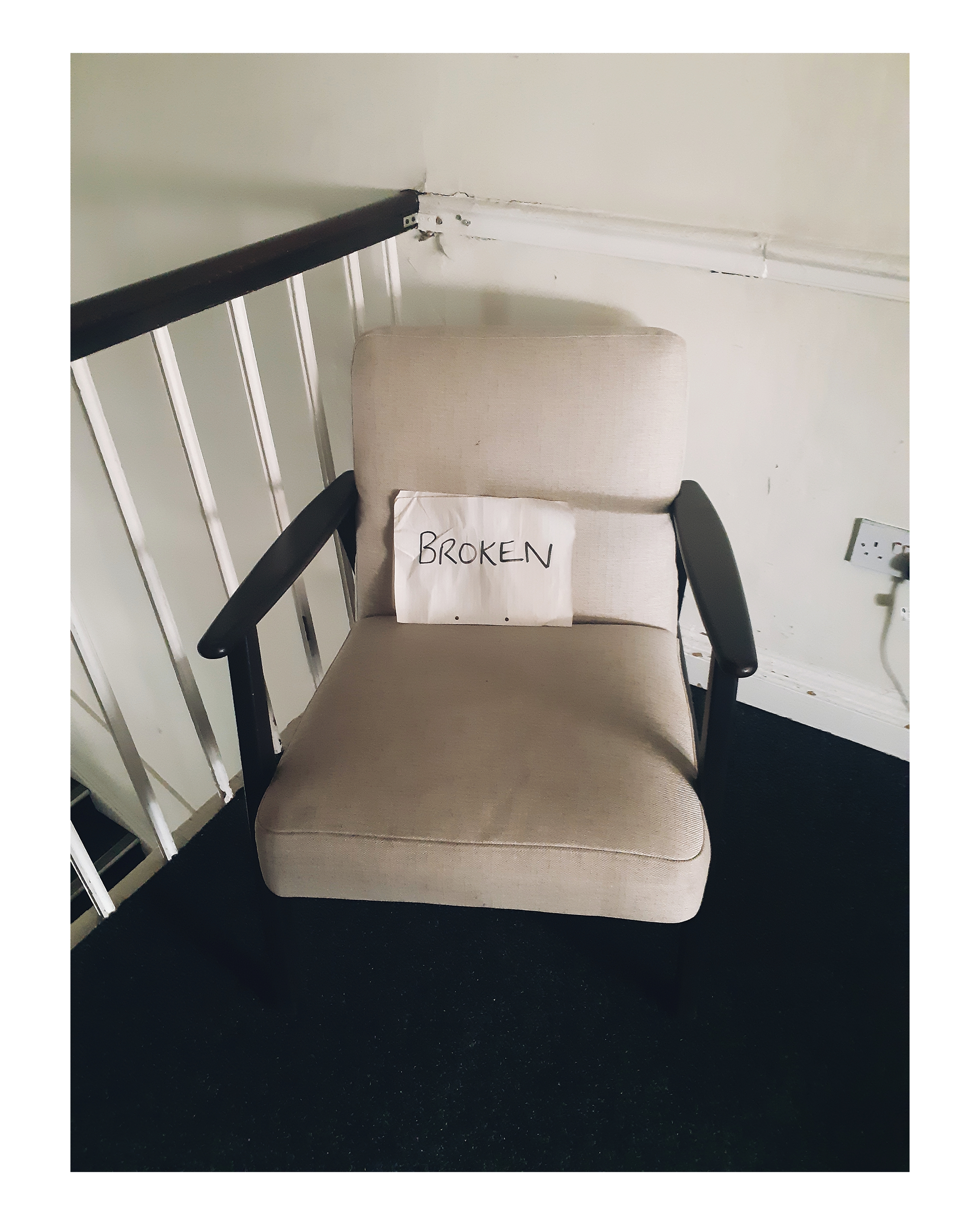
    And yet, I find myself increasingly drawn to them. Abandoned chairs, broken chairs, chairs that have been repaired, chairs that barely look like chairs at all. I’ve been photographing them, drawing them, gazing lovingly at them, making them, and generally finding myself rather preoccupied with them.

    This rather avid love affair, alongside my interest in the chair as a structure and its relationship to the body, has led me to include it in my research. Although I’ve always found chairs alluring, I didn’t begin exploring this fascination through my practice until I started Structures of Remembering in 2025.

    Although I suppose I’ve been exploring the ideas behind Structures of Remembering long before I had a name for what I was doing.

    The body, memory, lived experience, the ways in which we carry things with us, and how making might allow us to process what we don’t necessarily have the language for.

    I’ve spent much of my life living in my head, while my body has gone largely neglected. Which, come to think of it, might be another reason I’m so grateful for chairs.

    Before I go off on a tangent, which is so often the case, I think I should try to explain why I want to include chairs in my research.

    I wouldn’t say I’m close to nailing down my research question yet (not that I think there’s an expectation of that at this stage anyway), but I know it will build on concerns I’ve explored over the past four years of my practice, particularly repetition, embodied knowing, and how the process of making might allow something previously unrecognised to become perceptible.

    In my previous post, I began wondering what it is about repetition (another thing I’m obsessed with) that makes something previously unrecognised, or hard to articulate, perceptible. Not just in the finished work, but in me, in the material, and in the relationship between the two.

    And I suppose the chair offers me a familiar structure through which I might begin exploring some of these questions.

    It’s an object made in relation to the body. Something designed to support us, hold our weight, offer rest. But it can also suggest absence, vulnerability, or the failure of that support.

    And then there’s my own relationship with the chair, which I’ve begun to recognise differently through making and reflecting on the work.

    When I began Structures of Remembering in 2025, I wasn’t immediately conscious of all the associations I would come to make with it. Understanding slowly trickled in each time I returned to the work and reflected on my experiences; I began to recognise the chair as a structure that held particular meaning for me.

    A chair has been a place where I’ve felt held. Somewhere I’ve been anchored enough, surrounded by other chairs, to begin exploring experiences that had felt contained and suppressed within me for much of my life.

    Perhaps that’s why the chair keeps calling to me. Not simply as a symbol of support or absence, but as a familiar structure I can return to, repeat, alter, dismantle and remake.

    The key points are…

    • My interest in chairs predates Structures of Remembering, but I’ve been exploring them through my practice since 2025.
    • The chair offers a familiar structure for exploring relationships between the body, support, presence, and absence.
    • Repetition, embodied knowing, and the relationship between making and recognition have been recurring concerns throughout my practice.
    • Returning to my work and reflecting on my experiences has allowed me to recognise personal associations with the chair that weren’t necessarily apparent when I began.
    • I don’t need a definitive research question or a clear understanding of what the chair means just yet. Making, repeating, dismantling and remaking might offer ways of exploring these questions.

    So, more chairs it is, then.

  • Post 6: (Wk. 1) – I Forgot What I Was Remembering…

    Post 6: (Wk. 1) – I Forgot What I Was Remembering…

    I’ve always been a slow processor. I tend to realise things way after the fact. A bit of a space cadet, perhaps. Something happens, I wander off, and then sometime later I find myself going, ohhh… so that’s what that was about.

    Maybe that’s why returning feels so familiar to me.

    Sometime in the middle to the end of last year, I began a body of work called Structures of Remembering. Some of the early work was shown as part of the group exhibition Traces: drawings, sketches and a fragile sculptural form, all circling around the image of a chair.

    At the time, I wrote:

    These works are traces of a process still unfolding—early thoughts, fragments, and impressions that hold the beginnings of a larger body of work.

    I wasn’t entirely sure what that larger body of work was yet.

    I knew there was something about the chair that I wanted to stay with. Its relationship to the body interested me. A chair is made in relation to a body. It holds its weight, offers support, invites presence, and when left empty can somehow make an absent body more visible. I was thinking about presence and absence, vulnerability, gathering, witnessing, healing and isolation. But mostly, I was circling. Making. Looking. Trying things out.

    And then life happened.

    I put Structures of Remembering on the back burner. Or perhaps I just forgot that there isn’t always such a clear distinction between art and life.

    I didn’t abandon it completely. I returned occasionally. Made something. Drew something. Picked at an idea. Left again. Some things were allowed to grow quietly in the background.

    Now, as I begin my MA, I’m digging some of those things up again.

    The idea that something can become known through making before I can articulate it through language isn’t entirely new to me. I’ve encountered it through other projects: making first, understanding later. What I hadn’t necessarily considered was whether the things I make might also be traces of that process—material remnants of trying to know, remember, or process something.

    Or perhaps I had considered it.

    I’m trying to remember.

    There is something quite fitting about not being sure.

    Looking back at what I wrote for Traces, I was already describing these works as “traces of a process still unfolding”. But I think, at the time, I understood that largely as the unfolding of a body of work: early thoughts, experiments and fragments that might eventually become something else.

    Now I’m wondering whether the process they trace is something less straightforward.

    Perhaps the making itself records a process of coming to know.

    I can see questions emerging that I couldn’t fully articulate at the time. The chair was there. The body was there, even in its absence. Ideas around support, vulnerability, presence, absence and what remains were there. I just didn’t know yet what they were becoming.

    Of course, I’m still not entirely sure.

    This isn’t to suggest that the work secretly contained an answer that I hadn’t figured out yet. That feels far too neat. Maybe making simply gave me somewhere to put things while I was still trying to understand them.

    I’m curious about what might happen if I approach the chair more deliberately from here. Not necessarily as a symbol with a fixed meaning, but as an object to think through—a structure I can return to, repeat, alter, dismantle and remake.

    If making can be a process of coming to know, what is left behind by that process? Could the things I make be understood as remnants of an encounter with something I couldn’t necessarily articulate beforehand? And if some of that knowing happens through the body, could what remains become a material record of what the body knows?

    I don’t know what that record would look like, or whether record is even the right word. Perhaps that’s something I want to test.

    Perhaps the chair gives me a structure through which to test this. It already carries a relationship to the body—holding it, supporting it, bearing its weight, registering its presence and making its absence visible. I want to see what happens when I keep returning to it through different materials, processes and repetitions.

    I don’t know what I’ll find yet. That’s the beauty of not knowing, I guess.

    Perhaps that’s why repetition and return keep finding their way into my work. I make something, leave it, encounter it again, and find that something has shifted. Sometimes the thing has changed. Sometimes I have. Usually, I suspect, it’s both.

    Something happened.
    Something remains.
    Something returns.
    But never quite the same.

    Perhaps putting Structures of Remembering aside wasn’t an interruption to the work at all. There was simply an interval.

    And life happened in it.

    Bodies continued. Relationships shifted. Things were lost, repeated, remembered and forgotten. Life kept accumulating. I just wasn’t calling it art.

    Maybe I’m not picking the project back up.

    Maybe I’m encountering it again.

    And this time, I’m looking at what remains.