Tag: Ambiguity

  • Post 18: (Wk. 6) – Improvisation, Repetition and Other Things…

    Post 18: (Wk. 6) – Improvisation, Repetition and Other Things…

    I feel like I haven’t kept on top of things lately. I can’t even remember the last time I shaved my legs (for me, but still…).

    One of the many things I’m enjoying about the course so far is that it really is designed to match the rhythm of our individual lives. Except the rhythm of my life seems to be coming from a one-woman band, and she’s playing all the instruments strapped to her body with one arm. She has one leg, rides a skateboard and is dragging a grand piano for purely sentimental reasons, all while her five-year-old says ‘mum’ every two seconds.

    Nonetheless, things are wonderful, and I do love a bit of improv.

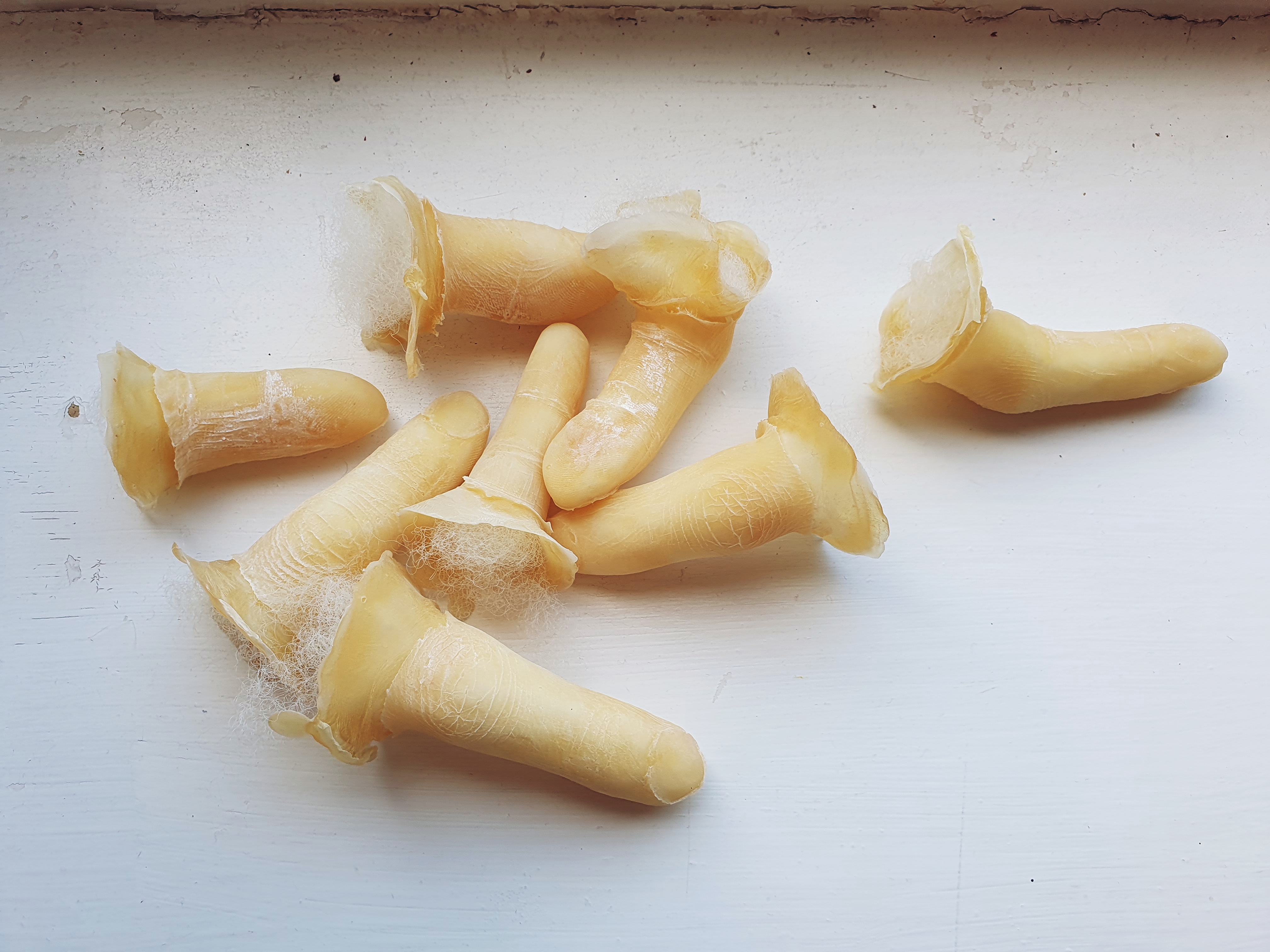
    Luckily, improvisation fits well with my practice. Earlier this week (or was it last week? Pfffphh… who needs to understand time?)I started making moulds of my fingers in alginate and pouring plaster into them to make a series of master moulds. At that point, I thought they were pretty groovy objects on their own.

    But then I decided (oh surprise) to coat these plaster moulds in latex using a simple brush-on technique. I used some handy polymorph plastic I had lying around (great stuff!). I stuck them to a piece of wood and spent the day building up layers of latex-y goodness.

    I showed these images to a friend, who initially thought I was making something other than latex finger casts, but we won’t get into that.

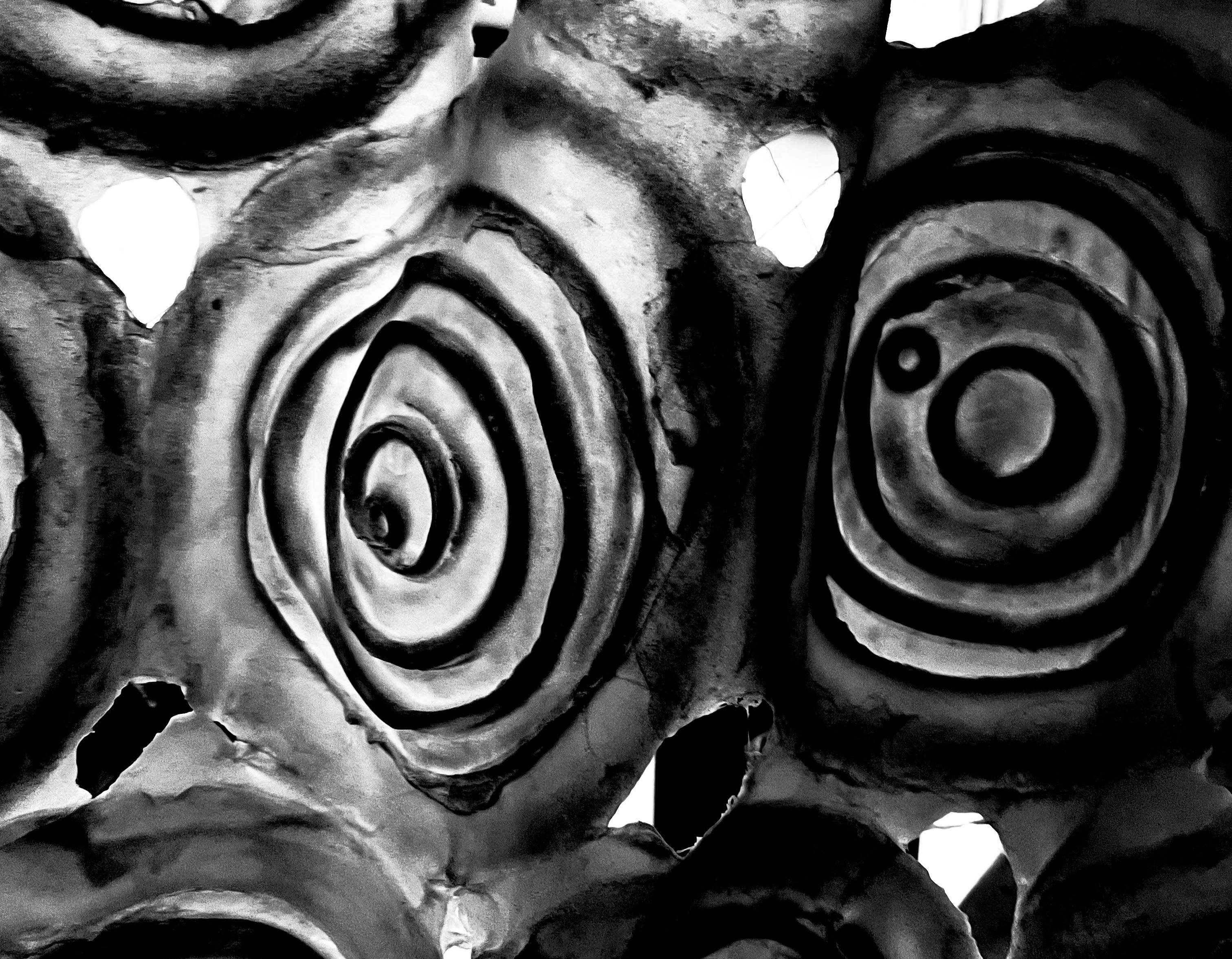
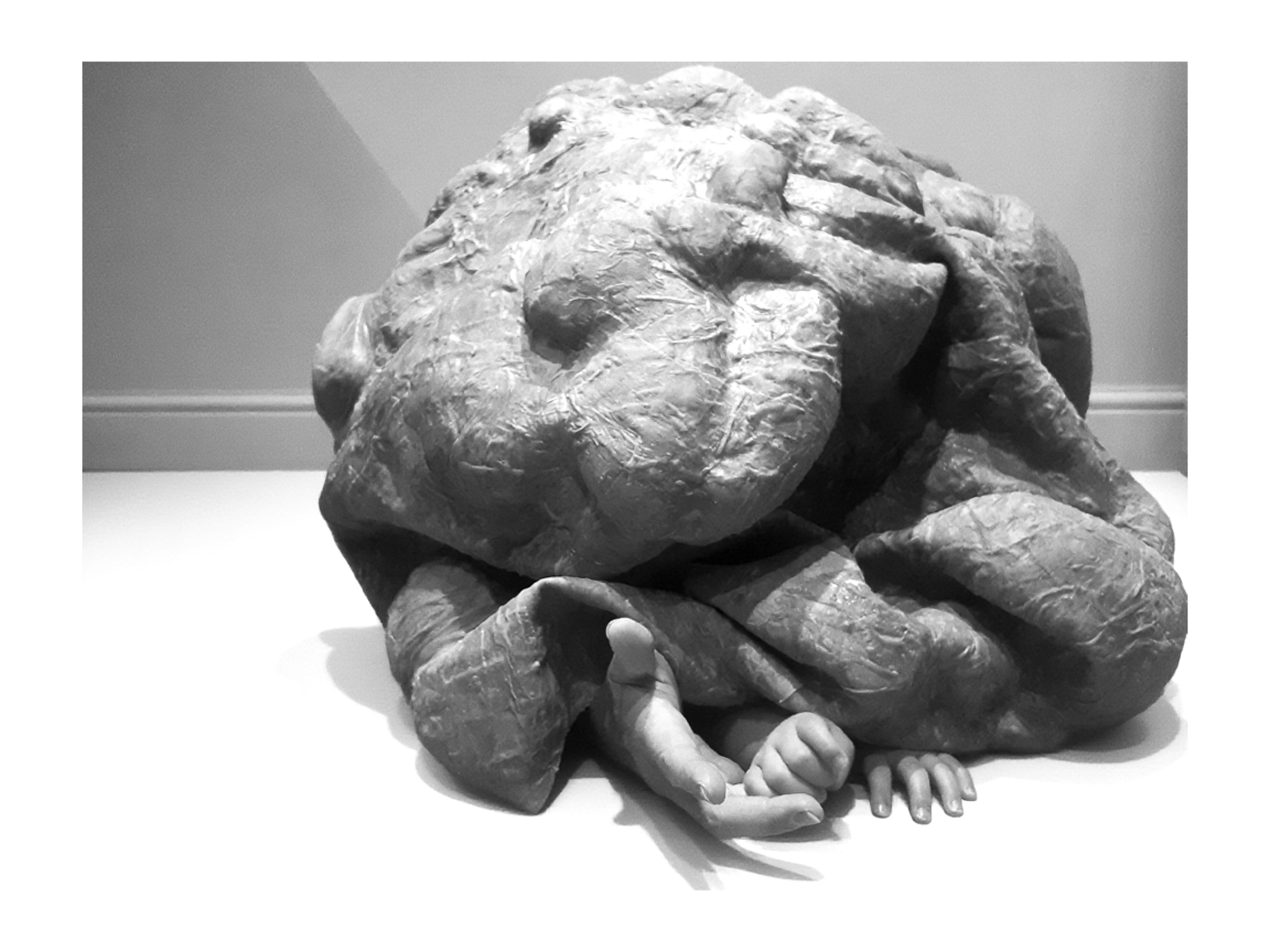
    Anyway, from these phallic-y fingers—I mean fingers—I arrived at what I feel is a very satisfying outcome of the process so far. Another example of making that wasn’t predetermined, but developed through an encounter with something I’d already made. (IMPROV!)

    I love how latex has this incredible capacity to register even the finest details. Its surface becomes a record of contact, capturing, so intricately, the marks of something that was once present.

    It holds the memory of its encounters.

    Beyond material memory, there is also remembering through making. I’ve returned to an existing form: my fingers, which make so many things possible. Remade in plaster, they are translated once again into another material, with different physical properties and possibilities.

    During the pauses over the last couple of days, I’ve kept repeating this process, gradually building up these half-familiar, half-ambiguous forms made from my body.

    My body is both the origin of these forms and the agent of their transformation.

    Through casting, recasting and accumulating these forms, my fingers, which are so familiar to me that I barely even notice them, begin to become increasingly unfamiliar.

    An interesting relationship emerges between repetition, difference and estrangement.

    And then I came across this image from an old sketchbook. Apparently, I’ve been circling these ideas for quite some time!

    I’d previously encountered Deleuze’s ideas about repetition and difference through Bracha L. Ettinger’s writing, but also through my own making. And here I am, returning to them again, although not quite in the same way.

    What’s particularly interesting is that repetition doesn’t simply produce more of the same. It can change our relationship to the original. Something that was always present, but perhaps rarely consciously noticed, becomes visible in a different way.

    And perhaps that’s what’s happening with my research, too. I’m returning to something I’ve encountered before, but I’m encountering it differently because of everything I’ve made and experienced since.

    There’s something rather fitting about that. Even my research seems to be repeating itself!

    I wonder: am I repeating these forms to remember something, or is the repetition helping me discover something I didn’t know was there?

    Perhaps both.

    Key points…

    • Improvisation as a method of making and exploration.
    • Making as a process of encounter and discovery.
    • The relationship between material, touch and memory.
    • Material as a carrier of traces and impressions.
    • The relationship between presence and absence.
    • The body as both the origin of forms and the agent of their transformation.
    • Repetition as a method of exploration and return.
    • The relationship between repetition, difference and estrangement.
    • The familiar becoming unfamiliar through repeated encounters.
    • Returning to earlier ideas and encountering them differently.
    • Remembering as a process of discovery rather than simply recollection.
    • Making as a process of questioning rather than finding definitive answers.
  • Post 14 (Wk. 4) – The Audience in my head…

    Post 14 (Wk. 4) – The Audience in my head…

    I missed last week’s lecture because I had my daughter with me for the first half of her half-term holiday, so I’ve been catching up with the recording.

    Something Mido said has stayed with me. She was talking about how difficult, perhaps even impossible, it feels to make work without considering an audience. Even when she’s creating something for herself, there’s always the possibility of someone else seeing it somewhere in the back of her mind.

    And I thought, yes, I do that too.

    Not that everything I make ever gets seen. Far from it.

    A considerable amount of my work lives in the attic, often in various stages of ‘dress’. Half-formed sculptures, unfinished experiments, abandoned ideas. A whole field of unfinished thoughts and lost dreams. Will they reawaken?

    But even when I’m making something that may never leave that space, I recognise that little awareness of someone else potentially encountering it.

    An imagined audience.

    And I wonder how much that awareness influences what I make, or how I make it.

    Later in the discussion, Illy spoke about wanting to create work that inspires a sense of awe in an audience. But what interested me was that he also wanted to experience that awe himself, as he already does, both through the process of making and through the outcome. (I can relate to this too).

    I found myself thinking about the difference between those experiences.

    There’s the experience of making something, with all its uncertainties, discoveries, frustrations and occasional moments of wonder. And then there’s the experience of encountering it, whether as the artist or as someone seeing it for the first time.

    They’re not necessarily the same thing.

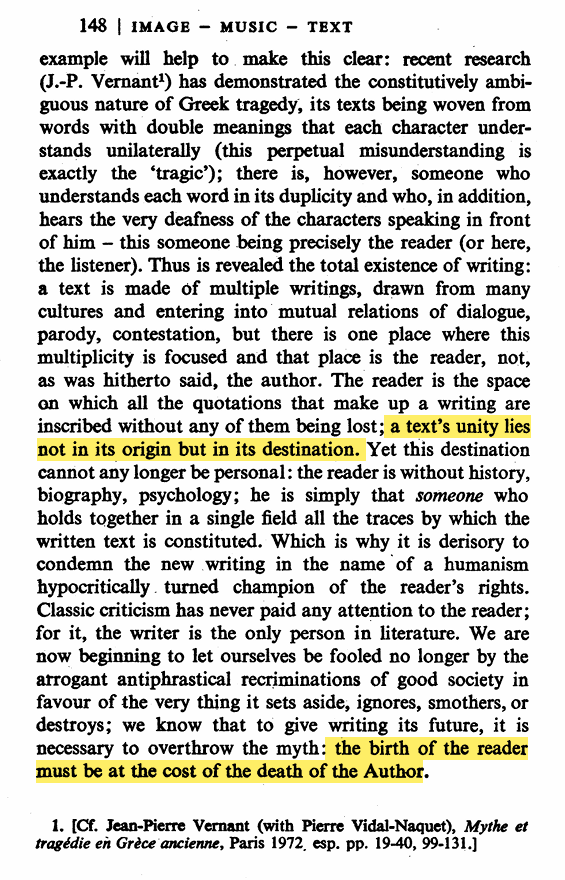
    Which reminded me of Roland Barthes and The Death of the Author.

    In his essay, Barthes writes:

    “A text’s unity lies not in its origin but in its destination.”

    — Roland Barthes, The Death of the Author, in Image–Music–Text (1977), p. 148.

    As I understand it, Barthes challenges the idea that the author’s intentions determine the meaning of a work. Once something exists beyond its creator, it becomes open to interpretation. The person encountering it brings their own experiences, beliefs, memories and associations.

    And whatever meaning they find might be quite different from what the artist intended.

    Not that the artist’s intention disappears, but it no longer has the final say.

    I’ve always found that rather interesting.

    We can spend so much time thinking about how something might be received, even though we have very little control over what someone else will actually take from it.

    We might hope to create awe, discomfort, recognition, connection or any number of other experiences. But we can’t guarantee any of them.

    And perhaps that’s part of what makes art interesting in the first place.

    It also makes me think about my own relationship with the objects I keep returning to.

    I’ve written about how, for me, certain objects become metaphorical anchors, helping me navigate things I can’t always articulate. But those meanings are mine, shaped by my experiences and the things I bring to the work.

    Someone else might encounter one of my chairs, for example, and see something entirely different.

    And actually, so might I.

    When I return to something I’ve made months or years later, I’m not necessarily the same person who made it. I bring new experiences, different questions, perhaps a little more understanding, or perhaps even less!

    So, in some strange way, I become an audience for my own work.

    And the meaning isn’t necessarily fixed for me either.

    Which brings me back to Mido’s observation.

    If we can’t entirely control how our work is received, why does the possibility of someone else seeing it occupy so much space in our minds while we’re making it?

    I find, more often than not, that imagined audience is a source of self-consciousness.

    It’s strange, really. I’m making something as a way of discovering what I don’t yet know, while simultaneously imagining how someone else might perceive it. Anticipating a response to something I haven’t even finished understanding myself!

    And I wonder what that does to the process.

    Does it make me more cautious? Less willing to experiment? More concerned with producing something that looks like art, rather than allowing myself to discover what the work might become?

    There’s a difference between wanting to share something and feeling as though I need to justify it.

    And perhaps that’s where I need to pay attention.

    Because I don’t think the audience itself is the problem. I love the possibility of connection, of something deeply personal resonating with someone whose experiences might be entirely different from mine.

    But I don’t want the anticipation of that encounter to determine what I’m willing to make.

    Especially when I have so little control over how it will be received anyway.

    And somewhere upstairs, my attic full of half-dressed sculptures and unfinished ideas continues to exist, largely untroubled by whether anyone ever sees them.

    And there’s something to learn from that.

    Key points…

    • An imagined audience can make me self-conscious and influence how I make.
    • Wanting to share my work is different from feeling I need to justify it.
    • I cannot control how others interpret my work.
    • Returning to my work can reveal new meanings.
    • Allow myself to discover through making, without worrying about how it will be received.
    • Unfinished doesn’t mean abandoned.
    • Some ideas may be waiting to reawaken.

  • Post 11: (Wk. 3) – My Body Knows Love…

    Post 11: (Wk. 3) – My Body Knows Love…

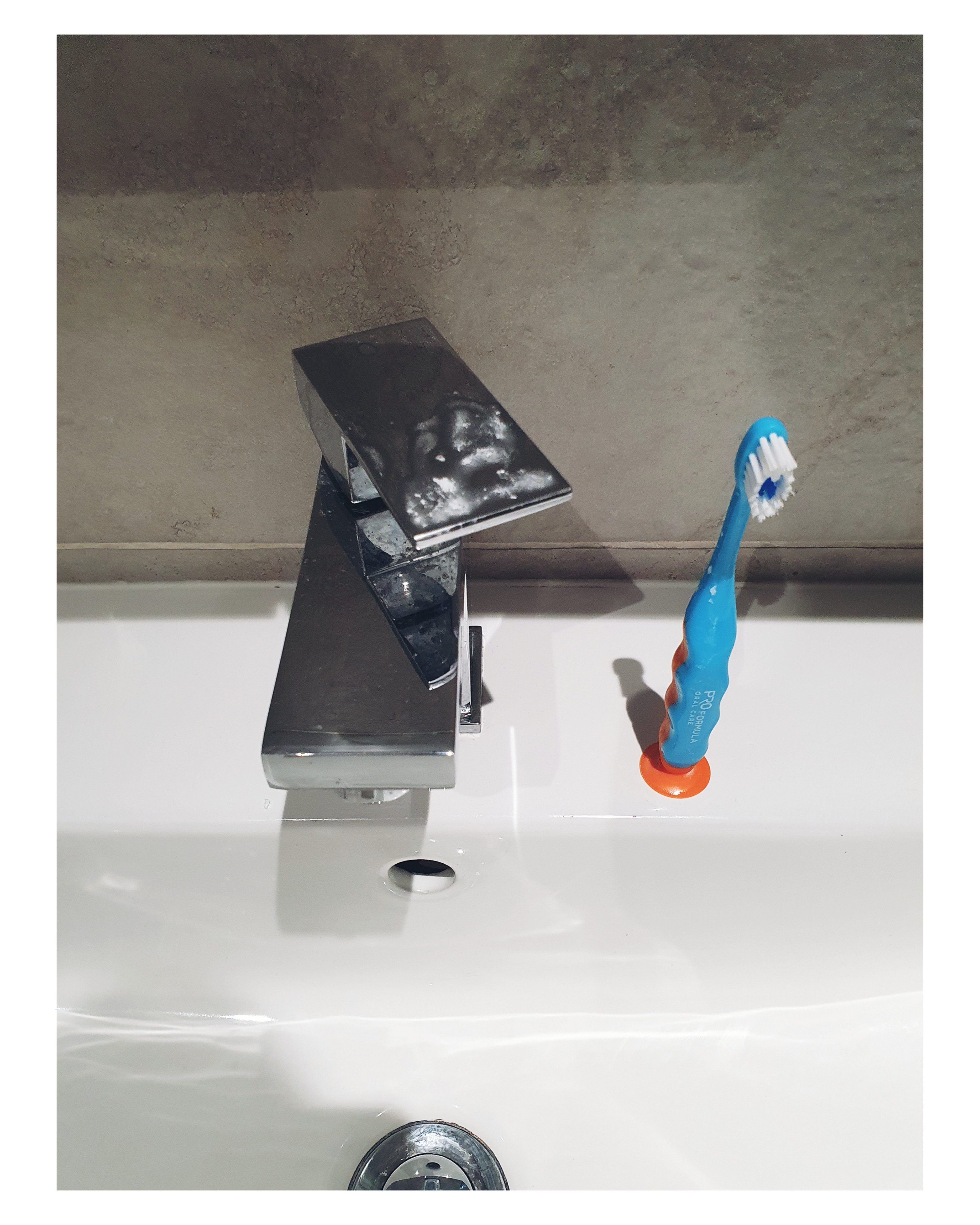
    I’d cleaned the bathroom the day before, and there it was. Dried toothpaste on the tap, left by my daughter after brushing her teeth.

    And that trace reminded my body that I know love.

    I photographed it moments later. Something about that ordinary little mark had moved me enough that I wanted to capture it.

    I’ve been thinking about my relationship with ordinary objects, and how certain things seem to evoke something in me that goes far beyond what I’m actually looking at.

    I’ve noticed how often I tend to give human qualities to inanimate objects.

    I remember walking into the bathroom one day and seeing the shampoo leaning against the conditioner, and thinking, “Oh, isn’t that lovely, they’re comforting each other.”

    Which is quite ridiculous, really. They’re shampoo and conditioner.

    But that’s genuinely what I saw.

    I wonder whether this tendency developed, at least in part, through experiencing a prolonged period of turbulence. Perhaps it was an attempt to find connection. Although I have a great deal of connection in my life now, I still do it.

    And I think there’s something deeply personal about all of this for me.

    Having spent many years disconnected from my body, looking outside of myself for answers, or perhaps simply the absence of pain, and relying on my own thinking, which was so often rooted in fear, I feel as though I’m encountering my body again.

    More often than not, this has left my internal compass spinning endlessly and erratically.

    And yet, I have this sense that my body has known things all along. Things I suppressed, dismissed or simply didn’t trust.

    I wonder whether these encounters with ordinary objects and traces are moments in which something my body already knows becomes available to my awareness.

    The shampoo and conditioner weren’t traces of a particular experience. I saw something relational in their arrangement. The toothpaste, on the other hand, was a physical trace of my daughter’s presence, and encountering it brought a recognition of love into my awareness.

    Perhaps both have something to do with the ways my lived experiences shape what I notice, and what I recognise, in the world around me.

    And then there’s making.

    I think when I make, I connect with my body in ways I don’t always manage to when I’m busy ticking all the boxes of everyday life. There are experiences, feelings and things I seem to know through my body that aren’t necessarily accessible to me through thinking alone.

    Sometimes, through the very physical act of creating, something becomes recognisable that I hadn’t previously been able to articulate. Other times, the process itself transforms what I thought I knew.

    Perhaps these are different ways of remembering. Not necessarily recalling a particular event, but returning to something within myself, or encountering it differently.

    I’ve been drawn to chairs, but there are other things that draw me too. Ordinary objects, arrangements, little remnants of everyday life that somehow bring something into my awareness.

    And I’m beginning to wonder what makes something a structure of remembering.

    Is it the object itself? The trace of an experience? Or something about the relationship between my body, the material and the encounter?

    And what about the objects I make? Do they become records of those moments of connection and recognition? Do the materials retain something of the encounter through the marks, gestures and processes involved in making them?

    Or do they become things I can return to, allowing further recognition and transformation to take place?

    Perhaps it’s not simply the finished object that interests me, but what happens through the encounter with the material, and what might continue to happen when I return to it.

    I’m not sure yet whether these objects are traces, records, structures of remembering, or something else entirely.

    But I think I might be getting closer to understanding what it is I’m trying to explore.

    The key points are…

    • My lived experiences may shape the relationships and meanings I perceive in ordinary objects.
    • Material traces can bring something I already know through my body into conscious awareness.
    • After years of feeling disconnected from my body, I’m exploring what it means to reconnect with and trust my embodied experience.
    • Making offers another way of encountering bodily knowing. Sometimes it allows recognition, and sometimes it transforms what I thought I knew.
    • I’m questioning whether structures of remembering might be the objects themselves, the material traces of making, or the relationships and processes through which remembering becomes possible.
    • Perhaps the objects I make are not simply records of previous encounters, but things I can return to, allowing further recognition and transformation to take place.

  • Post 10: (Wk. 3) – Noticed How Much I Love a Chair…

    Post 10: (Wk. 3) – Noticed How Much I Love a Chair…

    Other than needing to sit down a lot because, well, my body is knackered at the ripe old age of 36, I absolutely love a chair.

    I notice them everywhere.

    I can’t say for sure, but I imagine they’re among those objects that largely go unnoticed. They’re part of the quotidian, the everyday. So familiar, perhaps, that we barely give them a second thought.

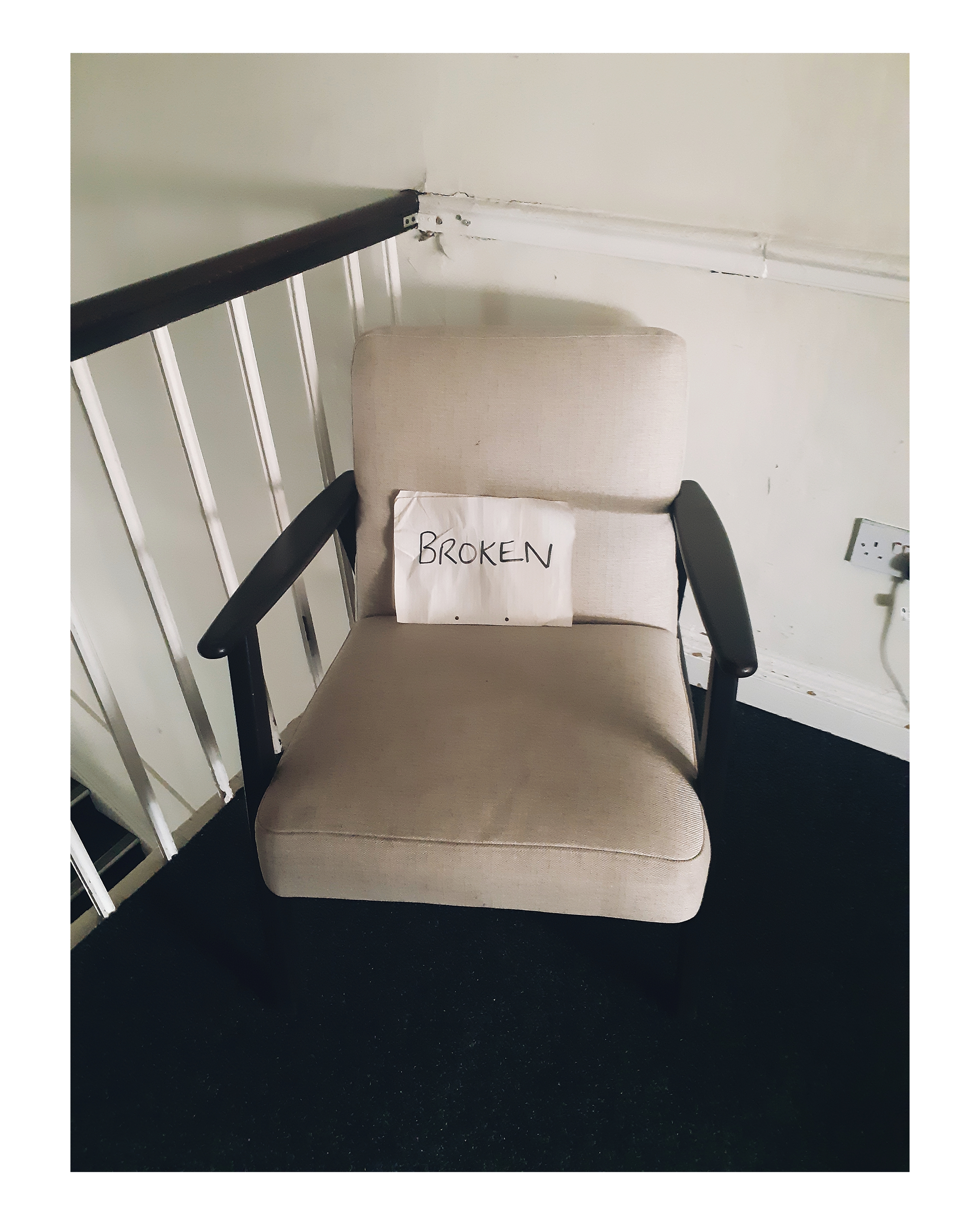
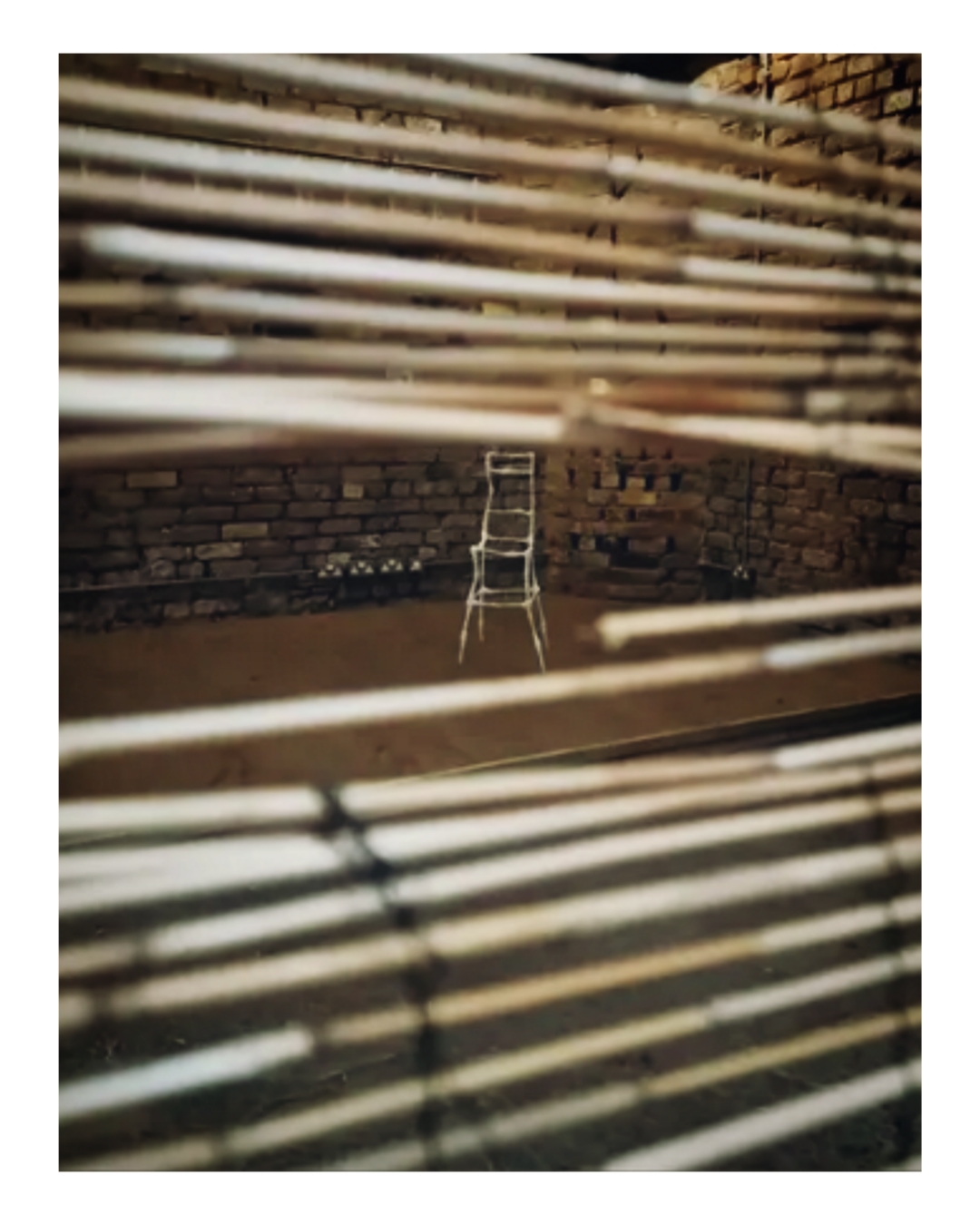
    And yet, I find myself increasingly drawn to them. Abandoned chairs, broken chairs, chairs that have been repaired, chairs that barely look like chairs at all. I’ve been photographing them, drawing them, gazing lovingly at them, making them, and generally finding myself rather preoccupied with them.

    This rather avid love affair, alongside my interest in the chair as a structure and its relationship to the body, has led me to include it in my research. Although I’ve always found chairs alluring, I didn’t begin exploring this fascination through my practice until I started Structures of Remembering in 2025.

    Although I suppose I’ve been exploring the ideas behind Structures of Remembering long before I had a name for what I was doing.

    The body, memory, lived experience, the ways in which we carry things with us, and how making might allow us to process what we don’t necessarily have the language for.

    I’ve spent much of my life living in my head, while my body has gone largely neglected. Which, come to think of it, might be another reason I’m so grateful for chairs.

    Before I go off on a tangent, which is so often the case, I think I should try to explain why I want to include chairs in my research.

    I wouldn’t say I’m close to nailing down my research question yet (not that I think there’s an expectation of that at this stage anyway), but I know it will build on concerns I’ve explored over the past four years of my practice, particularly repetition, embodied knowing, and how the process of making might allow something previously unrecognised to become perceptible.

    In my previous post, I began wondering what it is about repetition (another thing I’m obsessed with) that makes something previously unrecognised, or hard to articulate, perceptible. Not just in the finished work, but in me, in the material, and in the relationship between the two.

    And I suppose the chair offers me a familiar structure through which I might begin exploring some of these questions.

    It’s an object made in relation to the body. Something designed to support us, hold our weight, offer rest. But it can also suggest absence, vulnerability, or the failure of that support.

    And then there’s my own relationship with the chair, which I’ve begun to recognise differently through making and reflecting on the work.

    When I began Structures of Remembering in 2025, I wasn’t immediately conscious of all the associations I would come to make with it. Understanding slowly trickled in each time I returned to the work and reflected on my experiences; I began to recognise the chair as a structure that held particular meaning for me.

    A chair has been a place where I’ve felt held. Somewhere I’ve been anchored enough, surrounded by other chairs, to begin exploring experiences that had felt contained and suppressed within me for much of my life.

    Perhaps that’s why the chair keeps calling to me. Not simply as a symbol of support or absence, but as a familiar structure I can return to, repeat, alter, dismantle and remake.

    The key points are…

    • My interest in chairs predates Structures of Remembering, but I’ve been exploring them through my practice since 2025.
    • The chair offers a familiar structure for exploring relationships between the body, support, presence, and absence.
    • Repetition, embodied knowing, and the relationship between making and recognition have been recurring concerns throughout my practice.
    • Returning to my work and reflecting on my experiences has allowed me to recognise personal associations with the chair that weren’t necessarily apparent when I began.
    • I don’t need a definitive research question or a clear understanding of what the chair means just yet. Making, repeating, dismantling and remaking might offer ways of exploring these questions.

    So, more chairs it is, then.

  • Post 7: (Wk. 2) – Anxious Alligator and Schrödinger’s cat…

    Post 7: (Wk. 2) – Anxious Alligator and Schrödinger’s cat…

    Conversations and Sun Worship -1, 2024. Johannesburg.

    Your mission, if you choose to accept it, will be to give an informal presentation of your art practice… “Who am I?”

    Here I am, contemplating my art practice before today’s lecture. What are my chief concerns? What drives me to discover? Where am I? Where am I going? Do I need to know? And what happens to an art practice when we’re asked to observe it, define it and put it into words?

    Well, I have an idea. But, as with most things in my life, it seems the more I know, the less I know. So I will try to put into whatever words are available to me a little something about my practice.

    Art is a vehicle that helps me try to bridge the gap between my inner and outer worlds. It is the ligament, the cartilage, the bone, the blood; the connective tissue.

    Although… is there even a gap?

    If we come to know through being bodies in the world, where exactly does the inner end and the outer begin?

    Another question.

    I make to understand. Or perhaps, more accurately, I make in order to encounter what I don’t yet understand.

    I am increasingly interested in the body as the first site of knowledge. There are things we know, carry and remember bodily that don’t necessarily arrive neatly packaged in language.

    This leaves me with a question I keep returning to: how might we give material language to bodily knowledge?

    Even as I write that, I wonder whether give is the right word.

    I’m not sure that I want to translate that knowledge exactly. Translation suggests something complete already exists, waiting to be converted from one language into another. My experience of making feels messier than that. Often I make first and understanding arrives later. Sometimes much later.

    I’m beginning to recognise this as a recurring rhythm in my practice: make, leave, return, recognise differently, make again.

    Perhaps the leaving is as important as the making. Life happens. I change. Memory changes. Things are forgotten. Other things accumulate. When I return to the work, I can’t quite encounter it from the same place.

    Maybe return isn’t only something my work is concerned with. Maybe it is part of my methodology.

    My chief concerns are around bodily knowledge — although I’m beginning to wonder whether bodily knowing is more apt — and how we access what the body knows, particularly when language isn’t enough to contain or communicate it. I believe our bodies are the first site of knowledge, but that doesn’t mean we always have immediate or conscious access to that knowing. Sometimes something might be discovered, recognised or processed through making, and even then, there may not be adequate words for what we find. But there is still a discovery.

    I think this concern comes, at least partly, from a frustration I’ve carried throughout my life around not being able to express certain experiences. I don’t believe I’m alone in this. So I’m interested in what making might offer in that gap. Can material encounter give us access to bodily ways of knowing? Can making bring something of that knowing into physical space without requiring it to first become verbal? And might that create a point of connection with someone else who recognises something in it too?

    What does bodily knowing look like? How do we access it? What becomes recognisable through making? And what remains afterwards?

    Perhaps I don’t need to understand everything I discover. Perhaps discovery and understanding aren’t even the same thing.

    Art is life. When I think about life, I think about living, and when I think about living, I think about action, movement, process…

    I don’t know what I think.

    And now I’ve managed to give myself another question:

    If the body is continually knowing, remembering and responding through lived experience, then what isn’t a structure of remembering?

    Hmm.

    I’ll come back to that.

  • Post 6: (Wk. 1) – I Forgot What I Was Remembering…

    Post 6: (Wk. 1) – I Forgot What I Was Remembering…

    I’ve always been a slow processor. I tend to realise things way after the fact. A bit of a space cadet, perhaps. Something happens, I wander off, and then sometime later I find myself going, ohhh… so that’s what that was about.

    Maybe that’s why returning feels so familiar to me.

    Sometime in the middle to the end of last year, I began a body of work called Structures of Remembering. Some of the early work was shown as part of the group exhibition Traces: drawings, sketches and a fragile sculptural form, all circling around the image of a chair.

    At the time, I wrote:

    These works are traces of a process still unfolding—early thoughts, fragments, and impressions that hold the beginnings of a larger body of work.

    I wasn’t entirely sure what that larger body of work was yet.

    I knew there was something about the chair that I wanted to stay with. Its relationship to the body interested me. A chair is made in relation to a body. It holds its weight, offers support, invites presence, and when left empty can somehow make an absent body more visible. I was thinking about presence and absence, vulnerability, gathering, witnessing, healing and isolation. But mostly, I was circling. Making. Looking. Trying things out.

    And then life happened.

    I put Structures of Remembering on the back burner. Or perhaps I just forgot that there isn’t always such a clear distinction between art and life.

    I didn’t abandon it completely. I returned occasionally. Made something. Drew something. Picked at an idea. Left again. Some things were allowed to grow quietly in the background.

    Now, as I begin my MA, I’m digging some of those things up again.

    The idea that something can become known through making before I can articulate it through language isn’t entirely new to me. I’ve encountered it through other projects: making first, understanding later. What I hadn’t necessarily considered was whether the things I make might also be traces of that process—material remnants of trying to know, remember, or process something.

    Or perhaps I had considered it.

    I’m trying to remember.

    There is something quite fitting about not being sure.

    Looking back at what I wrote for Traces, I was already describing these works as “traces of a process still unfolding”. But I think, at the time, I understood that largely as the unfolding of a body of work: early thoughts, experiments and fragments that might eventually become something else.

    Now I’m wondering whether the process they trace is something less straightforward.

    Perhaps the making itself records a process of coming to know.

    I can see questions emerging that I couldn’t fully articulate at the time. The chair was there. The body was there, even in its absence. Ideas around support, vulnerability, presence, absence and what remains were there. I just didn’t know yet what they were becoming.

    Of course, I’m still not entirely sure.

    This isn’t to suggest that the work secretly contained an answer that I hadn’t figured out yet. That feels far too neat. Maybe making simply gave me somewhere to put things while I was still trying to understand them.

    I’m curious about what might happen if I approach the chair more deliberately from here. Not necessarily as a symbol with a fixed meaning, but as an object to think through—a structure I can return to, repeat, alter, dismantle and remake.

    If making can be a process of coming to know, what is left behind by that process? Could the things I make be understood as remnants of an encounter with something I couldn’t necessarily articulate beforehand? And if some of that knowing happens through the body, could what remains become a material record of what the body knows?

    I don’t know what that record would look like, or whether record is even the right word. Perhaps that’s something I want to test.

    Perhaps the chair gives me a structure through which to test this. It already carries a relationship to the body—holding it, supporting it, bearing its weight, registering its presence and making its absence visible. I want to see what happens when I keep returning to it through different materials, processes and repetitions.

    I don’t know what I’ll find yet. That’s the beauty of not knowing, I guess.

    Perhaps that’s why repetition and return keep finding their way into my work. I make something, leave it, encounter it again, and find that something has shifted. Sometimes the thing has changed. Sometimes I have. Usually, I suspect, it’s both.

    Something happened.
    Something remains.
    Something returns.
    But never quite the same.

    Perhaps putting Structures of Remembering aside wasn’t an interruption to the work at all. There was simply an interval.

    And life happened in it.

    Bodies continued. Relationships shifted. Things were lost, repeated, remembered and forgotten. Life kept accumulating. I just wasn’t calling it art.

    Maybe I’m not picking the project back up.

    Maybe I’m encountering it again.

    And this time, I’m looking at what remains.

  • Post 5: (Wk. 1) – An Aftertaste…

    Post 5: (Wk. 1) – An Aftertaste…

    You know when you chew on something, and it leaves an aftertaste that you only recognise afterwards…

    Anyway, as usual I’ve retraced, unpicked, put it back together, jiggled it a bit, and new or further meaning has revealed itself. So I have a little bit more to add. I guess the first post wasn’t enough for today.

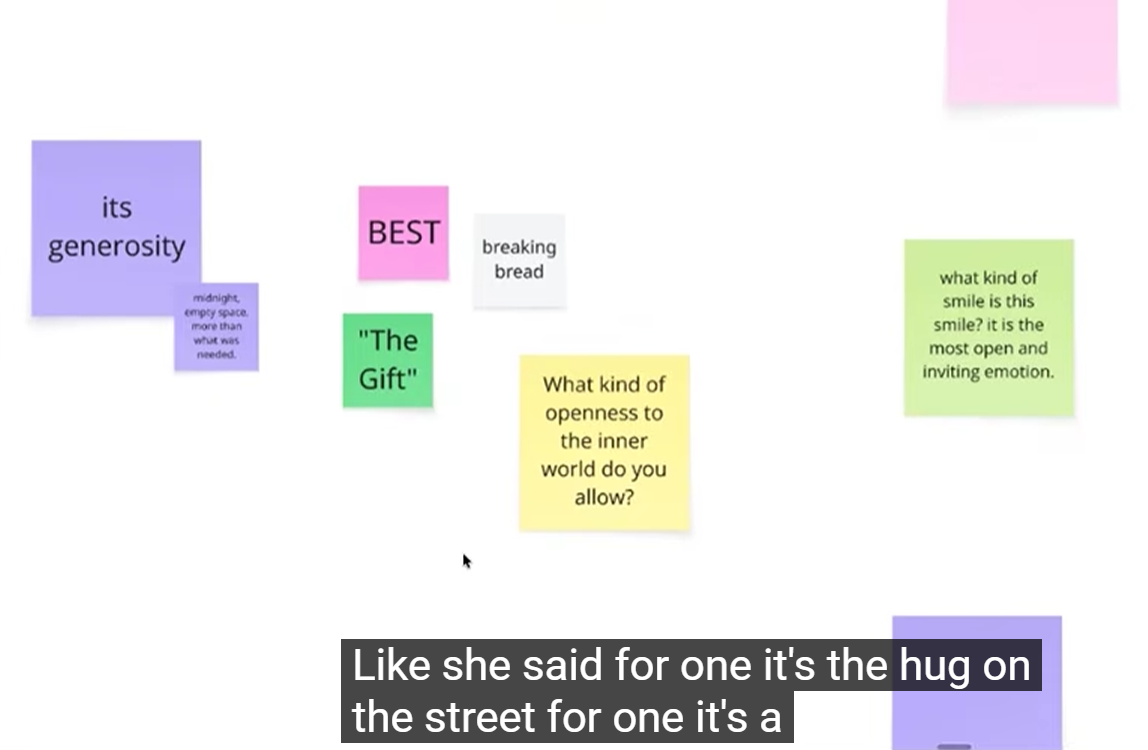
    I was thinking about how, when asked to reflect on what “kindness is like…”, so many of us took something which, in many respects, is quite abstract and described it through sensory or embodied experiences. There were existential and relational reflections too, but what interests me is how often we reach for something tangible, physical or experienced through the body to describe something felt in the body.

    A hug. A cup of tea. A warm blanket on a cold night. Breaking bread with a stranger. Listening. Smiling. Nourishment. A warm embrace.

    It’s like some things are easier to recognise through how they feel than through how we define them.

    Perhaps that is what I found so interesting about the exercise. None of this is necessarily new to me. The limitations of language, and the idea that the body might contain forms of knowledge that are difficult to articulate, are already central to my practice. But it brought me back to something I keep circling: how do we give the body a material language? Can making approach something that words can’t?

    I don’t mean simply using materials to represent an abstract idea, although that can be fun. I’m interested in whether something might actually become known through making. Perhaps bodily knowledge — the things we carry but cannot necessarily articulate — can be encountered through material, action and repetition. And perhaps what remains afterwards carries some trace of that encounter.

    A record of knowing? Not knowing? Remembering? Forgetting?

    I don’t know yet.

  • Post 3: Back to the Body…

    Post 3: Back to the Body…

    I’ve been trying to work out where to begin retracing this trajectory. The trouble is, the further back I look, the less convinced I am that there is a beginning.

    I carry with me a somewhat tumultuous history, and that followed me through the door when I walked back into art school after my daughter was born in 2021. What comes with this history are endless layers and blurred timelines that overlap and coil back on themselves.

    Just because the tapestry of my life creates an abstract image up close doesn’t mean that it has no meaning. There is. Lots. It’s just that most of that meaning seemed to have retreated into the sinews, nerves, muscle memory and fibres of my being.

    I didn’t have the words.

    That’s what they say about trauma. Sometimes an experience overwhelms our ability to process it as it happens. But just because something couldn’t be processed then doesn’t mean it wasn’t stored somewhere.

    The body…

    When I returned to art school, I quickly realised how difficult it was to remove context and self from the act of making. Whatever I made, there I was. My experiences, memories, the things I understood and those I didn’t yet have words for seemed to find their way into the work regardless.

    Perhaps what I didn’t understand then was that making was becoming a way of processing through the body what I couldn’t yet articulate in words. The actions, materials and repetitions weren’t simply illustrating an experience after it had happened; they were part of the process of trying to understand it.

    And what remained afterwards was, in some way, a record.

    Let Me Make Myself Pretty for You, 2022
    Single-channel video, 2 min 8 sec

    Let Me Make Myself Pretty for You… was a short film I made in response to a brief titled Extension to the Body. At the time, I approached the brief through the idea that the mind was an extension of the body. I was interested in the possibility that what we think and understand might not exist separately from bodily experience, but emerge through it.

    The title was deliberately ironic. In the film, I perform a ritual of making myself ‘pretty’, responding to internalised ideals of beauty and the anxiety of performing femininity — of being in a constant state of self-surveillance. As the ritual continues, however, I wrap Sellotape around my face. Rather than becoming increasingly ‘pretty’, the image becomes distorted, almost monstrous.

    Looking back, what interests me now is the gap between what I thought I was doing and what the work seems to reveal. I began with the idea of the mind as an extension of the body, but I don’t think I yet understood the implications of that. I made the work before I fully understood it. The action came first; some of the understanding followed afterwards.

    And perhaps this is one of the earliest places I can recognise something I am still trying to articulate: making as a form of embodied processing, with the work that remains carrying a trace of that process.

    Looking through the work that followed, this wasn’t an isolated occurrence. The body kept returning — sometimes deliberately, sometimes before I really understood why. Different works began to circle around similar questions: what the body knows, what it carries, and what might become visible through making that cannot so easily be articulated in words.

    Hold Space, 2024
    Multimedia installation, Bridewell Studios, Liverpool

    In 2024 I made Hold Space, a multimedia installation exploring the intermediate area of experience between mother and child. I was thinking about the relational space that exists between two people: where the boundaries of one body and another begin to blur, and where something might be held between them.

    Looking back now, I can also see Hold Space as a way of processing my own position between mother and child. I had become a mother myself, while still carrying the experience of being somebody’s daughter. The work was not explicitly autobiographical, but neither was I outside of it. My relationship with my own mother, my experience of becoming a mother, and the bodily knowledge of both seemed to find their way into the work.

    I think what I can recognise now is a shift taking place — from an interest in the body as a subject towards an understanding of the body as a site through which experience is known, carried and transformed.

    Un/body, 2025
    Multimedia installation, Liverpool Hope University, Liverpool

    This became more explicit in Un/body (2025), a multimedia installation in which I explored intergenerational transmission through my maternal genealogy. I wanted to uncover what I felt I might have inherited—experiences, patterns, and histories that seemed to exist within, or be carried by, the body.

    As part of the installation, I created moulds resembling nipples and used them repeatedly to produce latex forms. The repetition became important in itself. The act of making the same bodily form again and again became a space for processing something that was felt by the body but wasn’t necessarily available to me through language.

    The installation also included a soundscape made from recordings of women in my maternal family responding to a series of questions I had given them. Their voices brought other experiences and memories into the work, placing my own embodied experience within a wider maternal lineage.

    Looking back, I can see the body becoming more than something I was representing. It began to function as a kind of archive—somewhere experience could be carried, repeated, and transformed through making.

  • Post 1: Beginning Again…

    Post 1: Beginning Again…

    T. S. Eliot: ‘We shall not cease from exploration, and the end of all our exploring will be to arrive where we started and know the place for the first time.’

    To me, these words speak of repetition — of cycles, patterns and return. Each return bearing the fruits of new knowledge, of ourselves and of the external world. We might arrive where we started, but we do not necessarily arrive as the same person.

    Sometimes this inner knowledge, or the knowledge we draw from our experience as human beings within the world, is not easily articulated through words. Perhaps this is where making becomes another way of knowing.

    Repetition can become a practice through which we try to make sense of the senseless. But perhaps repetition can also create a new kind of sense — a kind of un-sense. Something that does not need to be fully articulated or understood in order to be known.

    So what does it mean to return?

    To repeat?

    To begin again?