Before the wonderful, knowledgeable CSM Fine Art library guy, Ben, kindly took us through the extensive library resources available to us (there’s even a materials collection—eeeeek!!!), we were given a small task.
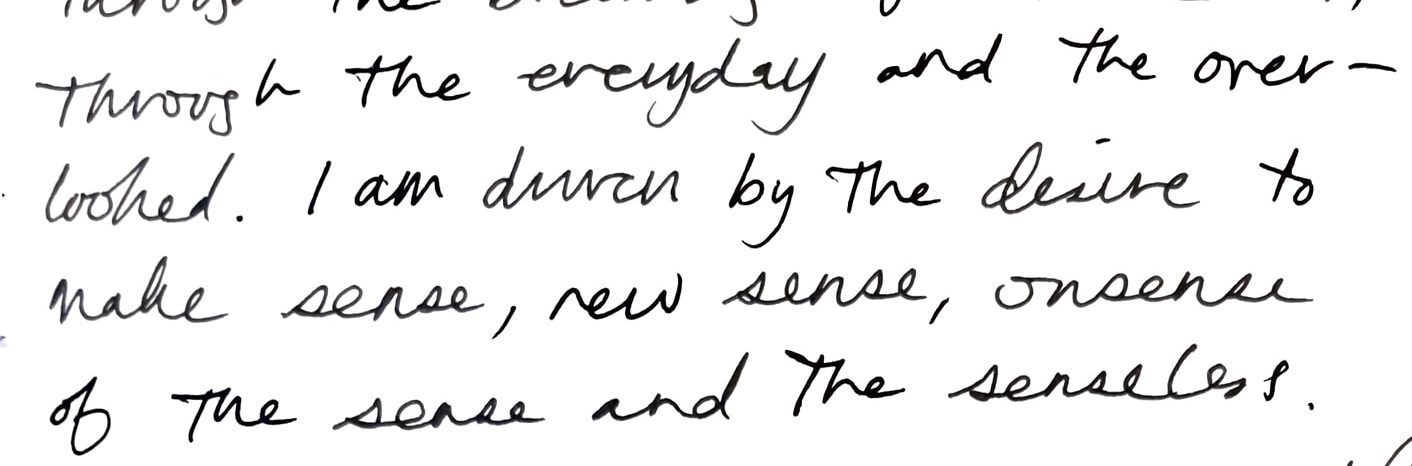
Jonathan asked us to grab a good old pen-and-paper combo and write freely for five minutes about our interests in relation to our art practice.
Below are the fruits of that exercise:
Interestingly, I didn’t explicitly mention repetition, return or multiplicity, three recurring pulls within my practice that I spoke about during my recent tutorial with Jonathan.
And yet, I think they’re present in what I’ve written, even if not explicitly named.
I speak of beginnings and ends, inner and outer worlds, connections. The cyclical. The carried. The inherited. The meanings hidden beneath the obvious. The physicality of feeling. Of making sense, new sense, and nonsense of the sense and the senseless (whatever sense that makes!).
Perhaps these are the things that interest me, while repetition, return and the multiplicity of materials and methods are the ways through which I explore them.
Although, on reflection, I’m not entirely sure the two can be separated so neatly. Perhaps repetition and return are not simply methods of making, but also part of what I’m trying to understand.
What I find particularly interesting is that, given five minutes to write without thinking too much about what I was going to say, I found myself returning to many of the same questions that have occupied my practice for years.
And there’s something in that, too. Writing freely, much like making, becomes a way of discovering what is already there, what might be emerging, and what I haven’t quite made sense of yet.
My dinner is ready. I’ll return shortly.
Went a bit overboard on the pepper.
Umm… yes, where was I? The free-writing exercise, alongside previous reflections, has given me a few more threads to follow. Perhaps the library catalogue Ben introduced us to today is a good place to begin.
Yesterday’s session began with the remainder of our cohort sharing their five-minute presentations. I found it incredibly inspiring to listen to everyone speak about their practices, what interests them, the questions they’re asking, and the different ways they approach making.
There’s something quite wonderful about being amongst people whose practices are so varied, yet who are all, in one way or another, trying to make sense of something.
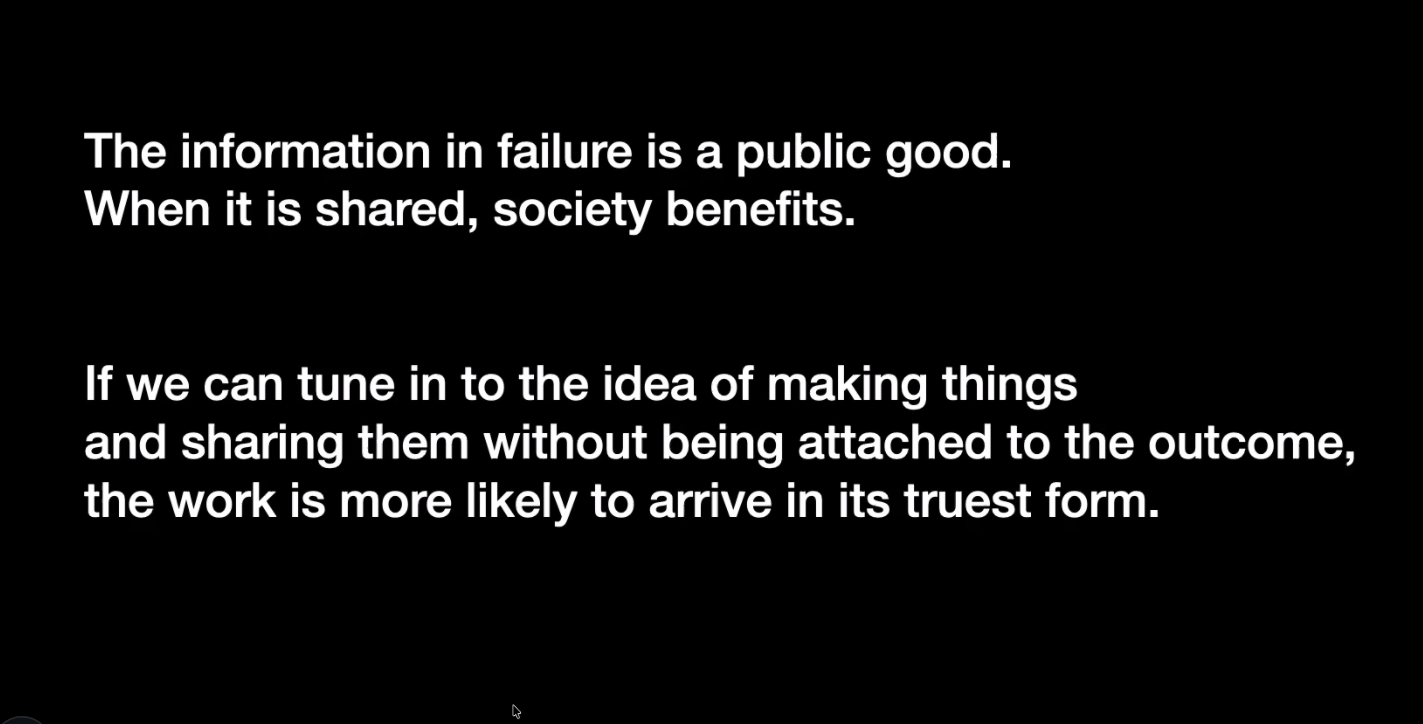
Jonathan, our course leader, went on to speak about failure and its significance within an artistic practice.
Initially, I found this a rather bleak prospect. Failure? Really?
After all, we live in a society that doesn’t exactly condition us to regard failure as something positive. If anything, we’re encouraged to avoid it. To get things right. To know what we’re doing and, preferably, where we’re going.
But as Jonathan continued, the idea took on a different meaning, one I’ve come to appreciate in my life.
He suggested that failure doesn’t really exist within an artistic practice if we’re willing to reflect on what happens and learn from it.
That makes sense. If something doesn’t turn out the way we anticipated, but in the process we discover something we didn’t know before, can we really call it a failure?
Surely, that is a success…
The timing of this conversation felt particularly apt, given that I’d only just delivered my own five-minute presentation.
I’d felt rather crumbly beforehand, and perhaps even more so afterwards. Not necessarily because anything had gone wrong, but because I think I’d become attached to an outcome. An outcome that, when I really think about it, wasn’t even measurable.
At least, not by anything other than myself and the things I tell myself.
And isn’t that interesting?
I’d been sitting there, listening to everyone else’s presentations, genuinely inspired by the richness and diversity of their practices, yet somehow struggling to extend that same generosity to myself.
It was as though I’d already constructed some idea of what a successful presentation ought to look or sound like, and then measured myself against it.
But whose expectations were they? And where had they come from?
Another idea that stayed with me was making and sharing work without becoming attached to its outcome.
But what does that attachment actually look like?
Perhaps it’s the desire for recognition, validation, acceptance, financial reward, or simply the reassurance that what we’re doing is worthwhile. All those things that, in one way or another, reach outside of ourselves for something to hold us up.
And I wonder what happens when we start measuring our worth against those external responses.
I think we become joyless.
What might once have been curiosity, play, or genuine expression becomes something to evaluate. We become so preoccupied with how something might be received that we lose sight of the pleasure of doing it in the first place.
And isn’t that rather ironic? In pursuing something we imagine will make us feel good, we risk sacrificing the very things that brought us joy to begin with.
We risk making decisions based not on what feels meaningful or necessary to us, but on what we imagine others will understand, accept, or reward.
And somewhere along the way, do we begin to filter ourselves? To dilute the very things that made the work meaningful in the first place?
This reminds me of a quotation by Keith Johnstone that Jonathan shared during the lecture, about the different rewards of saying yes and saying no. One offers adventure, while the other offers safety.
I find this distinction fascinating because neither response is without its reward. Safety can be comforting. But perhaps there is also a cost to remaining within the boundaries of what is familiar or acceptable.
What happens when the thing we rely on to hold us together is our own imagined judgement of how others might see us?
What do we lose when we spend so much energy anticipating others’ judgements, without ever really knowing what those judgements might be?
It reminds me of the spotlight effect in psychology: our tendency to overestimate how much other people notice us and what we do.
But perhaps we don’t just imagine ourselves being observed. Perhaps we begin to observe ourselves through the eyes of an imagined other. We become both the person being judged and the person doing the judging.
And somewhere in this strange exchange, we begin to edit ourselves.
How much of our attention shifts from the experience itself to managing how that experience might appear to someone else?
And what might become possible if that attention were returned to the thing we’re actually doing?
To making, exploring, experimenting, playing. To being present rather than performing an idea of ourselves.
I keep returning to something Zoë Duncan, who graduated from the course last year, said during the session:
“In losing ourselves we find ourselves.”
I wonder whether there’s something here about quietening the ego. About becoming less attached to who we think we ought to be, how we might be perceived, or what we imagine we should achieve.
But I suppose this resonates with me on a more personal level, too.
There was a time in my life when I lost myself to the point of complete unrecognisability. Strangely, it was only when I reached such eggshell fragility that I became willing to open my mind to the possibility of change.
Perhaps I’d become so attached to certain ways of thinking, being and understanding myself that I couldn’t imagine anything beyond them. Only when those familiar structures could no longer hold me did something else become possible.
And I wonder whether there’s a relationship between this experience and the process of making.
Not that we need to lose ourselves so profoundly to discover something new, but perhaps we do need to loosen our grip on what we think we already know.
To make space for uncertainty. For being wrong. For failure, even.
Because the more I know, the less I know.
Which brings me to that wonderful idea attributed to Socrates: “I know that I know nothing.”
There’s something liberating in that acknowledgement. In recognising that what we think we know, about the world or even ourselves, isn’t all there is to know.
Which, of course, I know!
Perhaps losing ourselves isn’t necessarily about becoming lost. Sometimes it’s about letting go of the things we’ve mistaken for ourselves.
And what might become possible when we’re no longer so concerned with holding them together?
A note to self: On failure…
A few scribbles from yesterday’s lecture, and a reminder for the next time I feel a little crumbly.
Share the experience. Accept what happened without necessarily approving of it. Make room for improvisation. And perhaps most importantly, create a little distance between myself and the experience.
Something might not have worked, but that doesn’t mean I am a failure.
There’s a difference between experiencing failure and making it part of who we are.