Reflection. Reflection. Reflection. Let’s see. How do I feel? Psychological safety. Yeah, that’s it. What a relief.
Today’s lecture helped settle my nerves. It’s hard not to project expectations onto new experiences when I would much rather inhabit a beginner’s mindset, but I’m happy to say that many of the expectations I’d built up around returning to study — and the anxieties that came with them — were massively alleviated today.
Everyone was lovely, encouraging, generous and engaged. I think we’re all eager to help nurture and contribute to this new creative community, and to expand as artists — as humans.
We were placed into separate breakout rooms, which gave us the opportunity to have three-minute one-to-ones with one another. It was like speed dating, but strangely humanising and intimate in a rather hilarious way. But hey, humour is a great icebreaker.
Once I’d got rid of the idea that perhaps we were part of some experiment where Zoom was the maze and we were rats in search of the big cheese, I felt myself starting to thaw out.
The biggest relief came with the permission not to know. No one was actually telling me that I should know, of course, but perhaps that was just another one of those preconceived ideas I had brought with me. Logically, I know that I am here to learn, question and discover, but knowing something logically and actually believing it are sometimes two very different things.
I wonder where my body picked up the belief that not knowing is somehow dangerous. Or at least, it seems to behave as though it is. There is an urge to know, to prepare, to anticipate, to get things right. Perhaps not knowing requires a certain amount of trust — trust that I can enter something without already knowing where it will lead.
Which is strange, because this is precisely the kind of uncertainty I value in my practice. I don’t always want to know where making will lead. I want to be surprised by it. So perhaps one of my intentions will be to learn to extend that same generosity toward myself as a student, as well as toward my peers. It’s comforting to be reminded that we are all, on this course and beyond, just trying to figure it out.
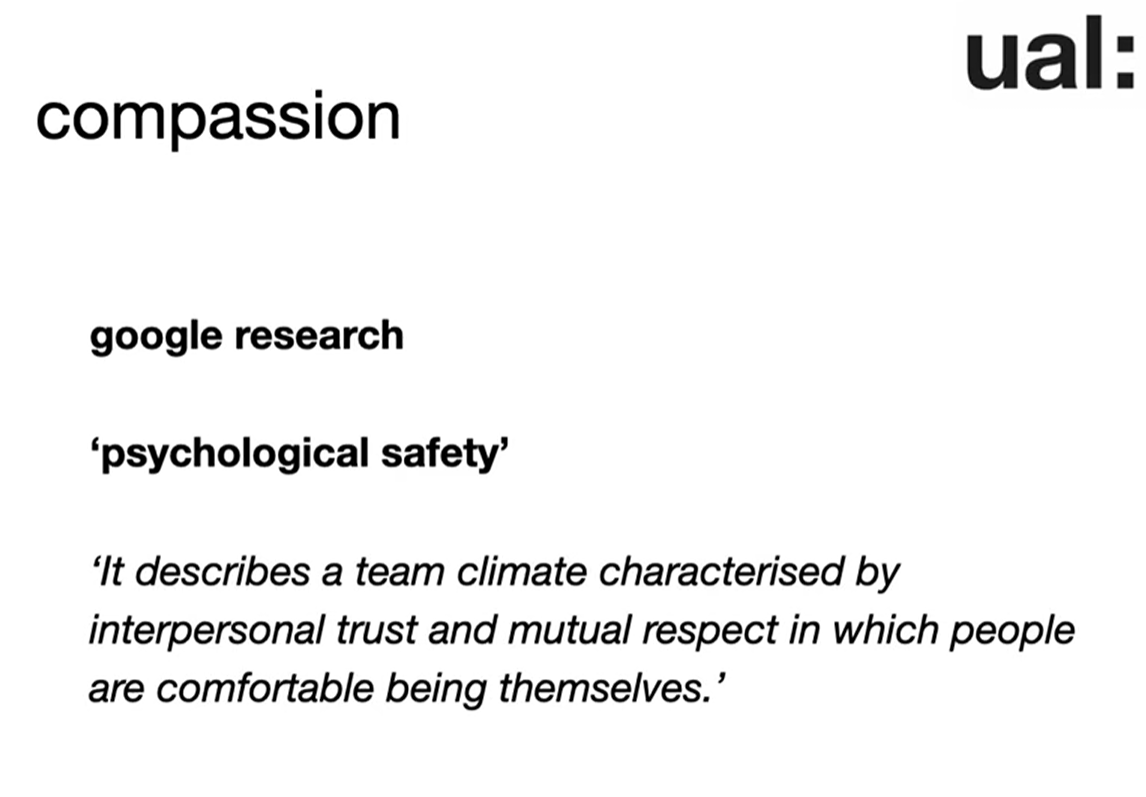
Another takeaway from today was the importance of psychological safety: having the opportunity to speak, experiencing openness and being met with empathy. Perhaps these are some of the conditions that make not knowing feel a little less dangerous. We can’t necessarily create psychological safety for one another, but we can each play our part in creating the conditions that make it possible.
And maybe that’s enough for day one. I don’t need to know yet. What a relief.
I’ve been trying to work out where to begin retracing this trajectory. The trouble is, the further back I look, the less convinced I am that there is a beginning.
I carry with me a somewhat tumultuous history, and that followed me through the door when I walked back into art school after my daughter was born in 2021. What comes with this history are endless layers and blurred timelines that overlap and coil back on themselves.
Just because the tapestry of my life creates an abstract image up close doesn’t mean that it has no meaning. There is. Lots. It’s just that most of that meaning seemed to have retreated into the sinews, nerves, muscle memory and fibres of my being.
I didn’t have the words.
That’s what they say about trauma. Sometimes an experience overwhelms our ability to process it as it happens. But just because something couldn’t be processed then doesn’t mean it wasn’t stored somewhere.
The body…
When I returned to art school, I quickly realised how difficult it was to remove context and self from the act of making. Whatever I made, there I was. My experiences, memories, the things I understood and those I didn’t yet have words for seemed to find their way into the work regardless.
Perhaps what I didn’t understand then was that making was becoming a way of processing through the body what I couldn’t yet articulate in words. The actions, materials and repetitions weren’t simply illustrating an experience after it had happened; they were part of the process of trying to understand it.
And what remained afterwards was, in some way, a record.
Let Me Make Myself Pretty for You, 2022 Single-channel video, 2 min 8 sec
Let Me Make Myself Pretty for You… was a short film I made in response to a brief titled Extension to the Body. At the time, I approached the brief through the idea that the mind was an extension of the body. I was interested in the possibility that what we think and understand might not exist separately from bodily experience, but emerge through it.
The title was deliberately ironic. In the film, I perform a ritual of making myself ‘pretty’, responding to internalised ideals of beauty and the anxiety of performing femininity — of being in a constant state of self-surveillance. As the ritual continues, however, I wrap Sellotape around my face. Rather than becoming increasingly ‘pretty’, the image becomes distorted, almost monstrous.
Looking back, what interests me now is the gap between what I thought I was doing and what the work seems to reveal. I began with the idea of the mind as an extension of the body, but I don’t think I yet understood the implications of that. I made the work before I fully understood it. The action came first; some of the understanding followed afterwards.
And perhaps this is one of the earliest places I can recognise something I am still trying to articulate: making as a form of embodied processing, with the work that remains carrying a trace of that process.
Looking through the work that followed, this wasn’t an isolated occurrence. The body kept returning — sometimes deliberately, sometimes before I really understood why. Different works began to circle around similar questions: what the body knows, what it carries, and what might become visible through making that cannot so easily be articulated in words.
Hold Space, 2024 Multimedia installation, Bridewell Studios, Liverpool
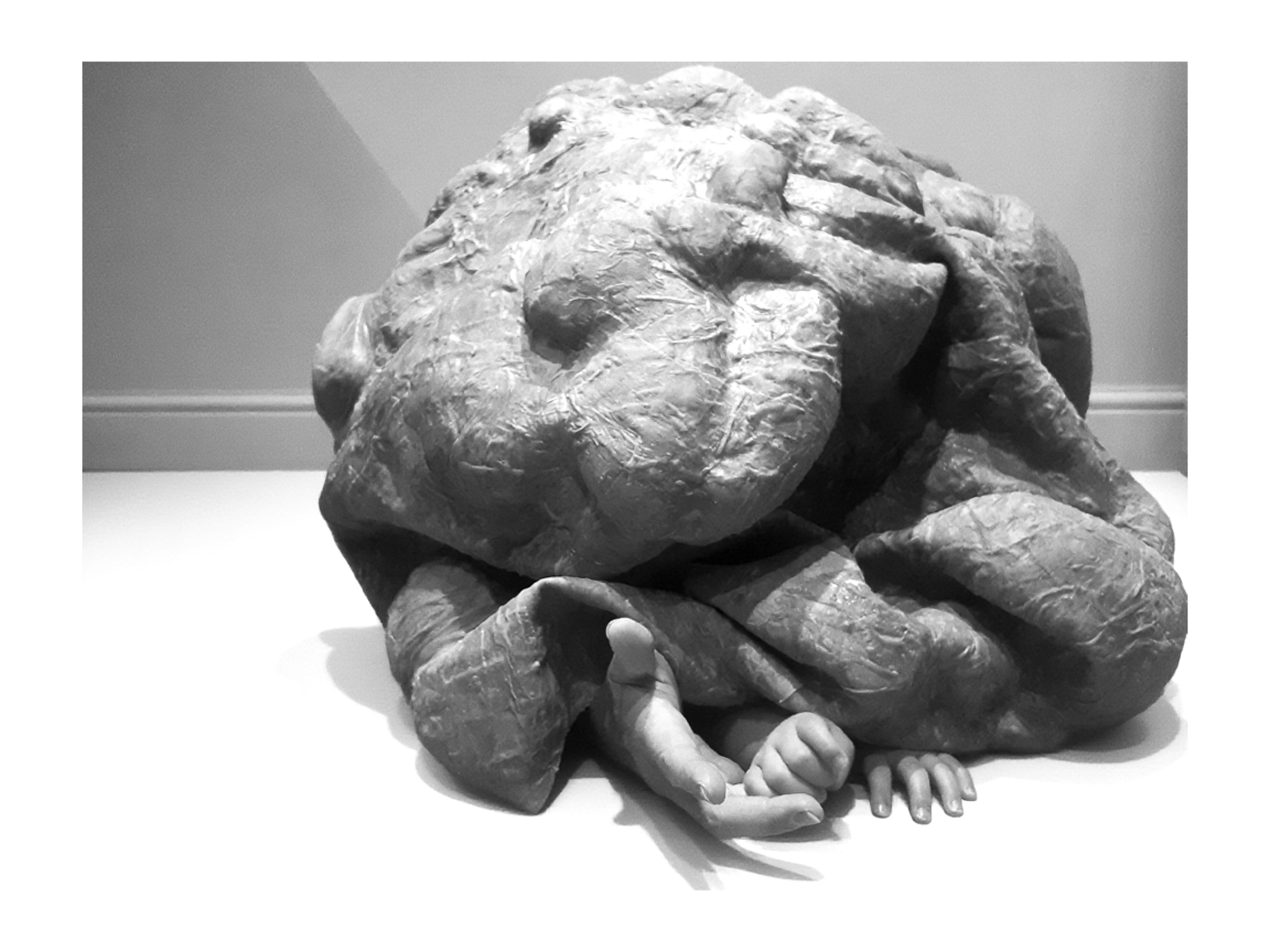
In 2024 I made Hold Space, a multimedia installation exploring the intermediate area of experience between mother and child. I was thinking about the relational space that exists between two people: where the boundaries of one body and another begin to blur, and where something might be held between them.
Looking back now, I can also see Hold Space as a way of processing my own position between mother and child. I had become a mother myself, while still carrying the experience of being somebody’s daughter. The work was not explicitly autobiographical, but neither was I outside of it. My relationship with my own mother, my experience of becoming a mother, and the bodily knowledge of both seemed to find their way into the work.
I think what I can recognise now is a shift taking place — from an interest in the body as a subject towards an understanding of the body as a site through which experience is known, carried and transformed.
Un/body, 2025 Multimedia installation, Liverpool Hope University, Liverpool
This became more explicit in Un/body (2025), a multimedia installation in which I explored intergenerational transmission through my maternal genealogy. I wanted to uncover what I felt I might have inherited—experiences, patterns, and histories that seemed to exist within, or be carried by, the body.
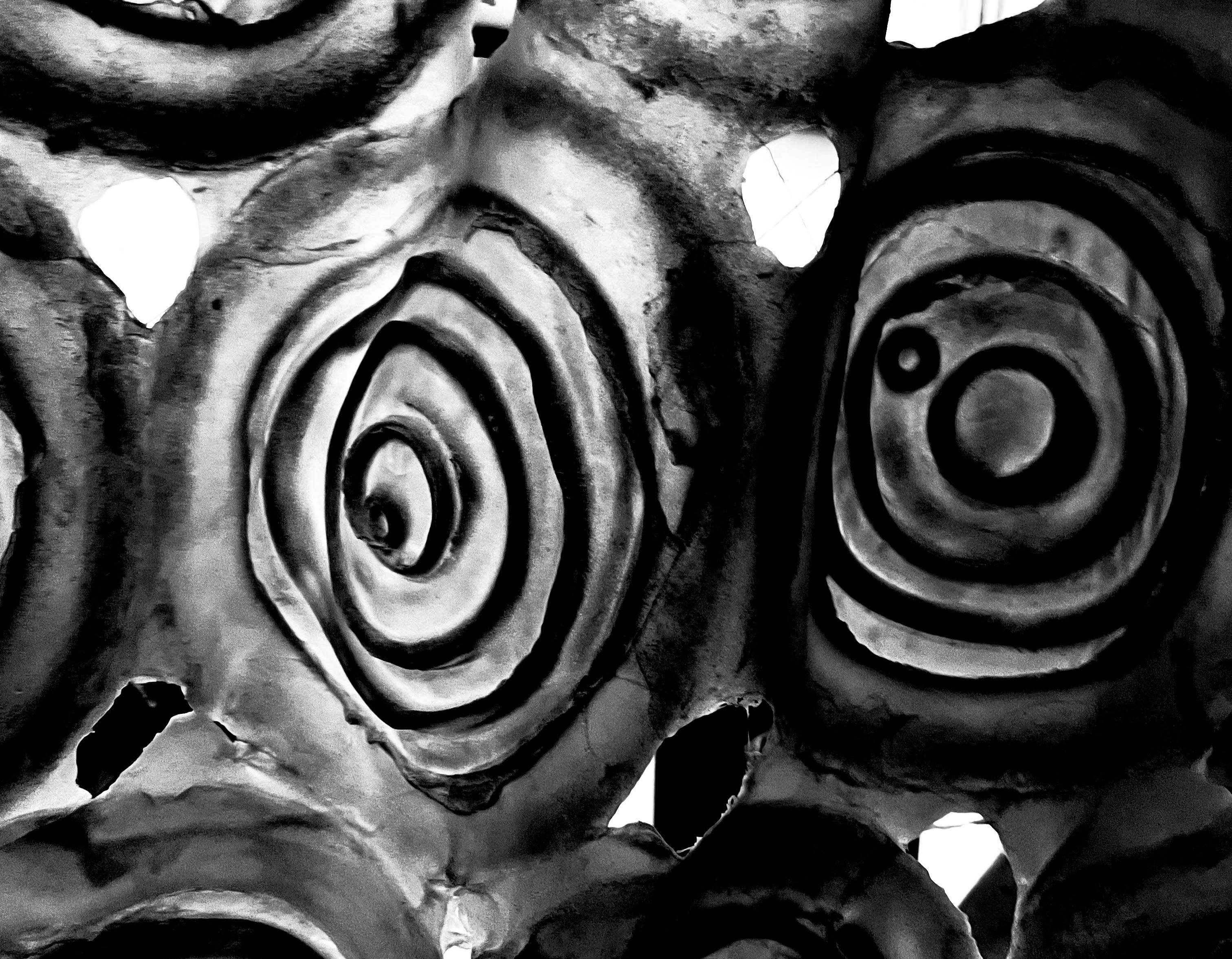
As part of the installation, I created moulds resembling nipples and used them repeatedly to produce latex forms. The repetition became important in itself. The act of making the same bodily form again and again became a space for processing something that was felt by the body but wasn’t necessarily available to me through language.
The installation also included a soundscape made from recordings of women in my maternal family responding to a series of questions I had given them. Their voices brought other experiences and memories into the work, placing my own embodied experience within a wider maternal lineage.
Looking back, I can see the body becoming more than something I was representing. It began to function as a kind of archive—somewhere experience could be carried, repeated, and transformed through making.
Hartenbos, South Africa, 2022. Photograph by the artist.
Next week I start my MA Fine Art: Digital journey, so I thought it would be best to start retracing some of the paths that brought me here (well, there, nearly).
I’ve had to take a short hiatus from making for the past few months while I learn to dance to a new rhythm in my life. Life is pesky like that sometimes; it shows up in all kinds of unexpected ways.
Ways that, as usual, seem to resist easy articulation, but are nevertheless felt and known.
I could give you a play-by-play of what has ensued, but it would just be a regurgitation of the facts as I see them, rather than the knowledge carried by the body through these experiences.
Which is what interests me. Not only my body, but bodies — the body as the first site of knowledge. Before we can articulate, explain or make sense of an experience, the body has already lived it. Felt it. Known it.
That’s where the good stuff lies — the real.
So, naturally, perhaps retracing is a good place to begin.
Not to construct a neat chronology of how I arrived here, because I’m not sure it ever happened that way. Looking back at my practice, the same questions seem to surface and resurface: the body, memory, repetition, maternal experience, rupture, what is carried, what is inherited, and what cannot quite be put into words.
I don’t think I necessarily knew that these were the questions I was asking when I began. In many ways, the making came first and the understanding followed —along with yet more questions. It’s as if the more you know, the less you know. But there is such teachability in that.
So, in retracing some of this trajectory, I’m interested not only in what I have researched and made, but in how one thing has led to another — how ideas have returned, shifted, accumulated and taken on different forms.
Maybe the best place to start, then, is with the body.
Throughout my practice so far, I have felt a deep desire to give physicality to feeling — to inner landscapes, to the bridges between inner and outer worlds. Perhaps this is because so many of those inner experiences have been felt in isolation.
Why do I attach one meaning to an experience, while another person might attach something entirely different? Sometimes that meaning is known only by the body. Attempts to convey these experiences through words — and the meaning I attach to them — never seem able to fully encapsulate what has been felt.
The materials, the processes, the making itself always seem to lead me back there. Back to the body. Back to this site, this beginning, where emotion precedes the word. Always.
So, what happens when meaning is known only by the body? How can that knowledge be made visible? How can it be recorded?
T. S. Eliot: ‘We shall not cease from exploration, and the end of all our exploring will be to arrive where we started and know the place for the first time.’
To me, these words speak of repetition — of cycles, patterns and return. Each return bearing the fruits of new knowledge, of ourselves and of the external world. We might arrive where we started, but we do not necessarily arrive as the same person.
Sometimes this inner knowledge, or the knowledge we draw from our experience as human beings within the world, is not easily articulated through words. Perhaps this is where making becomes another way of knowing.
Repetition can become a practice through which we try to make sense of the senseless. But perhaps repetition can also create a new kind of sense — a kind of un-sense. Something that does not need to be fully articulated or understood in order to be known.